Showing posts with label a violent distaste. Show all posts

9.27.2008

Climbing up a bloody great hill.

The President appeared on my tv the other night to deliver an address to the nation regarding the current financial crisis, and what action his administration and Congress plan to take to remedy it. In short, he wants us to do this.


Seems just a touch ironic when almost the whole of his two terms has been dedicated to persuasion through terror.

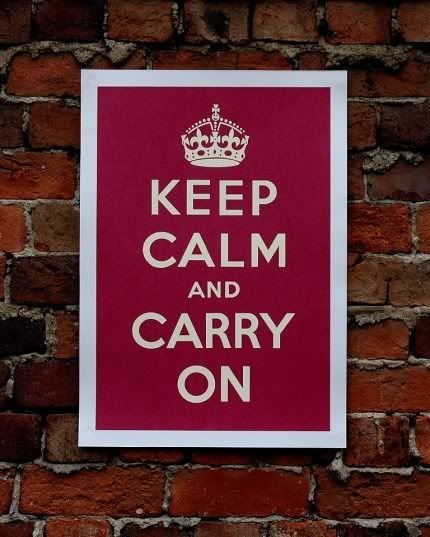
This poster was comissioned by the British government's Ministry of Information on the eve of their involvement in the war with Germany, and was meant to convey to the public an "attitude of mind" appropriate to the unknown and very dangerous situation they'd confront in the days and years ahead. Mr Bush is well-versed in the rallying cry of a well-timed piece of propaganda, and this country has, up to a point, been agreeable in the face of his decision to use its people as cannon-fodder. Our George, however, is not George VI; there is no Churchill on the horizon. And this is no longer a matter of stoicism and the acceptance of hardships with an eye to the greater good, and the surety that comes from suffering for the common cause. This is a matter of people's money, and I'm thinking it's not going to be a simple matter of telling everyone to buck up this time.

As I listened to the President I was aware of the fact that he wasn't talking to me. He was talking about mutual funds, mortgages, retirement accounts, and credit flow. I have none of those things, am in no danger of losing what I don't have, and so don't really figure into the equation. And it seems that more and more people might be joining me here among the ranks of those who really aren't a part of the fabric of American society. Clearly, to be of matter within it is to be tied to those slips of paper; when you take away a person's money, you take away their reality. Words are cheap to begin with, but even more so now. I'm wondering what words people will be speaking to themselves if they lose even a part of what they always assumed was so solid, if the institutions they believe in fail them. I'm wondering how much they can lose and still function, and what will happen once a little too much is taken away.

In Journey to the End of the Night, Louis-Ferdinand Céline writes about his experiences as a calvary officer in World War One. Early in the story his regiment is shelled by the Germans, his colonel is killed, and he is seriously wounded; somehow he escapes and makes his way to the rear, where he's put to work at a ration distribution point. He's just seen most of his fellow soldiers slaughtered, but remains full of his usual apocalyptic joie de vivre, until he's confronted with the sight of the regiment's butchers at work: "The squadrons were fighting tooth and nail over the innards, especially the kidneys, and all around them swarms of flies such as one sees only on such occasions, as self-important and musical as little birds.
Blood and more blood, everywhere, all over the grass, in sluggish confluent puddles, looking for a congenial slope."
And it's this moment, finally, that proves too much for him; he faints dead away.

It's interesting how we can become accustomed to almost anything, how we can ignore what horrifies us for so long, function despite the untenable situation staring us in the face, right up to the moment when it changes context and we see it as if anew, through defenseless eyes. It's interesting what happens to people, and what they'll do to survive, when that last, small piece of belief is taken from them.

9.11.2008

The right question.


Jeff Buckley--Haven't You Heard

The sound of the zeitgeist, putting aside the fact that it was recorded in 1996.
Who were you in 1996, and did you understand then what was coming? What will you do now that so often, and so infuriatingly, what comes and who you are aren't what you thought they would be?

I don't do politics here, and my brand of social commentary isn't of the naïf-in-scenester's-clothing or cutting satire variety. I don't have to cover any of these angles to know that we're in a fair bit of trouble, folks.

America is a palimpsest, as are we. Some of us decipher the underwriting, and some of us do the scraping. I know that we are being effaced in two ways: overwritten by a heavy-handed bureaucracy kissing the hem of religion and holding the trump card known as "patriotism"; and corroded to dust by our own indifference in the face of this.

I can remember who I was in 1996. The only question I can ask is which action to take--reveal what has been hidden beneath, or scour away what remains and start again from the ground?

9.03.2008

Want to disappear.


Well played, Jack White--well played.

I'm sure that in this moment Jack was simply expressing his frustration at the lack of rapport he felt with his audience, their lack of participation in the sweat and fury and fire he injects into every performance, but since I specialize in focusing on the moment, this one speaks to me of a larger issue I keep running up against.

Just when did it become the last word in social stances to be utterly unwilling to admit to any strong emotion, display anything other than a cool and detached disdain in all circumstances, or allow oneself to indulge in expressing enjoyment in front of (shock, horror) other people? For the hipster, the dismissive sneer and the blank stare are de rigeur. They coordinate beautifully with the Ikea nesting tables and sideboard, assembly instructions and unwavering apathy included.

I realize that I'm out of the loop. I realize that I am, in fact, terminally unhip. And this isn't an attempt to hark back to a less jaded, simpler time. It was always the mark of high culture and good breeding to cultivate the attitude of the hipster. As goes the self-appointed upper echelons of the trendsetters, those who define what nucleus of cool the hangers-on should cluster around, so goes the vegan dude in the drainpipe jeans and strategically unkempt hair at the 7-11.

In 1958 Jack Kerouac was invited to a symposium at Hunter College to debate the question "Is There a Beat Generation?". He was under the impression that he was there to read his poetry, and he was wrong. Instead he was asked to participate in poetry's dissection, to display himself for the bloodless academics, professors of anthropology and sociology, Village Voice reporters eager to bury the corpse and attend the birthing of the next literary happening. I can imagine Jack climbing that stage, a little the worse for drink, Jack who did nothing but feel a little too much for his own good and express that surge of feeling his whole life, I can see him sitting there with a glass of brandy, looking into the face of that sniffy disdain, wondering why.

Jack said,"And now there are two types of beat hipsters: the Cool, bearded, sitting without moving in cafes with their unfriendly girls dressed in black, who say nothing; and the Hot, crazy, talkative, mad shining eyes, running from bar to bar only to be ignored by the cool subterraneans. I guess I'm still with the hot ones. When I walk into a club playing jazz, I still want to shout." He also said, "You came here prepared to attack me."

We can be sure that this dichotomy between the hot and the cool has always existed, and the cool always looks to temper the hot, quenching it in the bath of the ironic gaze, not allowing it to bend into a new shape or send off such uncontrollable sparks. Jack must have known how apt the tag of "subterraneans" was--burying all that is spontaneous inside themselves, nothing freely given, and nothing transformative taken away. A few years before, in On the Road, he'd written, "You don't die enough to cry." Who decided that erasing all but the surface of this life is better than that death?

Two Jacks, wondering where everybody went.