Showing posts with label poets. Show all posts

10.14.2008

What lie must I keep?


I don't see myself anywhere but in that past...
I'm no prisoner of reason. I said: God. I want salvation to bring freedom: what do I do?...
If only God gave me heavenly, aerial calm, and the power of prayer--like ancient saints. --Saints! What strength! The anchorites were artists abandoned by the world...
Ah, to rise back to life! To look once again upon our deformities...
--But it seems my soul sleeps.
Were it truly awake from this moment forward, we would be approaching a truth that, even now, may be encircling is with her weeping angels!...
Finally, I ask forgiveness for feeding on lies. Okay: let's go...

It seems that in order to survive, we tell ourselves stories. We soothe ourselves with tales of how we became who we are, pore over the minutiae of our pasts as if they would point a way forward, arm ourselves against uncertainty with the names we've established and the possessions that tell us we've achieved something real and lasting, a comfort and a legacy we can rest in.

The religious have the promise of salvation, a simple plotline to follow that assures them of a satisfying ending; turn away from the temptations of the world, strip yourself of pride and face up to the multitude of sins that cling to you, and you'll find a place made for you at the side of God. The secular are mostly concerned with the image they've worked all their lives in the service of, the belief that there is a just reward waiting for them if they stick to the plan society recommends as the right one clung to just as fervently as any spiritual decree.

We tell ourselves stories, as children are told fairytales that order a world too large and frightening; the good prosper, sacrifice is rewarded, evil will always be caught out and punished by the righteous hand of justice. We'll be safe and happy, protected in the arms of a family and leaders that want us to succeed. If we follow the example of the hero and steer clear of the shadows, if we drop a trail of breadcrumbs so we'll always remember who we are and where we came from, we'll never get lost. There's no such thing as monsters, it's just your eyes that deceive you. Anyone who has reached the age of majority with their wits intact knows in their heart that the truth is not so simple, and never easy to recognize.

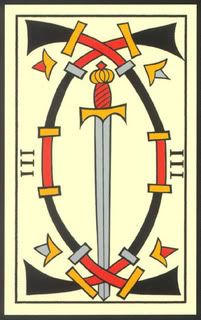
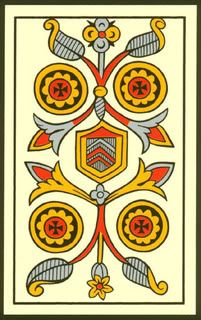
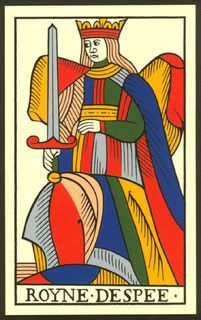
More often than not we suffer, and we walk around pregnant with our own shortcomings, carrying the suffering to the end as a badge of honor because there seems to be no other way of coping. Victimhood as a coat-of-arms is the extreme example of this; giving in to the comfort of admitting oneself powerless means there is no more need to keep trying. The Queen of Swords is traditionally viewed as a widow, a spinster, a woman without a partner, and of all the tarot queens she's the only one defined by a loss or what she lacks as opposed to her own personal characteristics. And here, she appears wary of anyone stripping her of that mantle; she isn't quite powerless, but she's resolutely turned away from the future, seated, and has no apparent interest in being otherwise. She looks to the shield, her name, her defenses, centered in the four coins that mark the boundaries of a life.

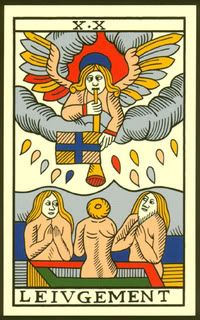
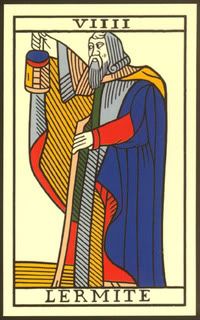
The Hermit seems to have a different approach. He's always been identified as some kind of seeker, and here he raises his lamp to Judgement; is it his own resurrection he's looking for? The Hermit is, as his name tells us, solitary, and the work of revising a life, of re-vision in the service of moving forward, is of necessity a solitary act. No one can know what's in our hearts but ourselves, and much as we might try we cannot hide what is buried there from ourselves. The Hermit is wise, to a point; he works in the service of illumination. But the act of looking backward to see what has already died, digging up the corpse of the past again and again to inspect the wounds, doesn't necessarily show us a way to avoid suffering them in the future. Too often we stop at recognizing that the moment for a profound upheaval has arrived; and too often we acknowledge it only because it blares in our ears and we can hardly ignore it any longer. The truth presses upon us, and we can sit in the coffin waiting for the revelation, or we can climb out on our own.

The lies others tell us, the lies we're expected to collude with in order to be received into society, are easy to see and resist if we choose. It's our own lies that are so insidious; it's the stories we tell ourselves as we wait for someone else's permission to begin the climb out of the hole we've dug that are so hard to resist. Seeking forgiveness from a god to whom we hand the reins of authority and resting our hopes for the future on the illusions of the past, buying in to the role we're expected to perform or becoming a reliquary that forever exhibits our own failings; these are comforts we can't afford to keep.

9.29.2008

Which hearts shall I break?


I lent him weapons, and a second face...
Hallucinations come, are without number...
No one is here, and yet someone is...Shall I disappear?
His kisses and embraces were a heaven, a dark heaven, into which I had entered, and where I would have preferred to have remained: poor, deaf, mute, blind. I got used to it. I saw us as two good children, free to stroll through Heavenly sadness...
Love must be reinvented. That much is clear...

How simple it is, to become caught in the web of illusions others project onto us. Like getting lost in a house of mirrors, bumping into a million reflections stretching back to infinity, turned around and around until you can't be sure if you're the image or the real thing; we can vanish entirely. We can become so fragmented and compartmentalized that we wear a different face for every occasion, all of them ill-fitting, locking away the parts of ourselves that others might find displeasing until we cannot be sure we exist at all without the gaze of another to tell us who we should be.

We wish to be loved and praised, we want to feel that we are part of some all-consuming and shattering romance, or failing that we'd at least like to feel as if we belong in the world. If we want this badly enough it's no great matter to assist in our own confinement, the little amputation required to fit an ungainly foot into the glass slipper, the emptying of the will it takes to become one of many cells in a hive. We're adept at erasing and re-drawing ourselves over and over again, sketching in a personality so tenuous it's nothing but a mass of crosshatching and ghostly afterimages.

As mutable and ill-defined as our own personalities can be, we would prefer that other people remain who we think they are; when they change too much, too quickly, it calls everything into question--the bonds we build so carefully, the contours of a loved one's life we fit into so well, a routine we thought stable as bedrock until the foundation shifts and slides away. Suddenly the picture is canted, and we're reminded that no matter how close we come to each other, there is always a door whose key we don't hold between.

In the absence of religion, people cling to their belief in the redemptive power of relationships with a passion; I can save her. Through love and understanding, I will save myself. When there is failure we feel as if we've been cast out, fallen from grace and drowned in our own separate hell.
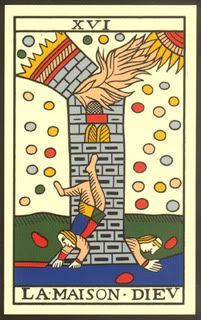
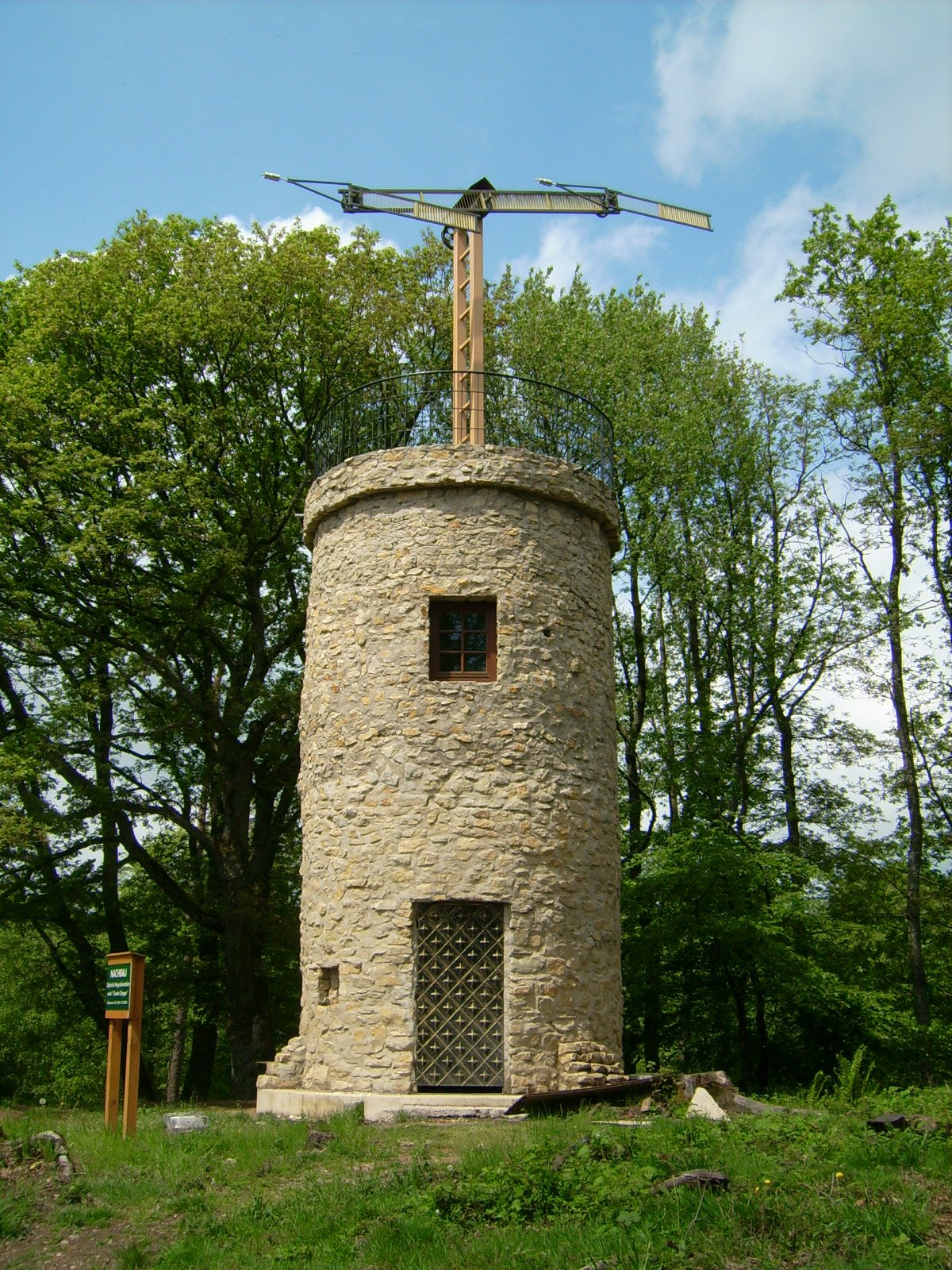
And so we're cautious, sending signals out from the tower in the hope they'll be received as we intended. We don't rock the boat, for fear of capsizing it. Compromise is necessary in any kind of relationship, but when it reaches the level of pathology and an identity is constructed entirely from self-sacrifice, when we're nothing more than a shadow on the lookout for a praiseworthy shape to take, we become as insubstantial as Sylvia Plath's "living doll", a frame for others to hang their wishes on: "You have a hole, it's a poultice. / You have an eye, it's an image.".
The eye is always voracious; the heart desires to beat for another despite the wounds it's so likely to encounter. It's easy to break apart, by ourselves and in our connection to others, and easy to forget that at the center is a place of power and self-reliance we can arm ourselves with, if we rid ourselves of the fears that nag like a thorn in the side.

9.24.2008

The pure products of America / go crazy.

And let's suppose for a moment we, I, do try to get free and fly off from that common morass the heart is so prone to settling in. Let's say this is more than just an exercise in literature, tarting up the corpse so it won't look quite as dead and we may admire it before closing the casket. Let's say I'm serious, let's say I'm working in the only ungoverned zone left to us; ideas as tangible agents of change. The age of philosophical and artistic manifestos is long over, and no matter how you slice it they were just another set of boundaries in novel costumes; we, the undersigned artists, exclude any vision not compatible with our own, and vow to slump into complacent old age once we've replaced our predecessors as the established brand-name of innovative thought. We have the formula, and we're locking it in the vault.

Is the entire aim of beginning to work the promise that we'll eventually reach an end? What end is there to reach when what we apply ourselves to isn't a product we can place on the market, when we step outside the arena of profit and loss, when there is no criterion against which we can measure how far we've come?

I wanted to be a writer. More specifically, I wanted to be a great writer, but I never asked myself why. Here in America we have a mania for producing, we're nothing without evidence of our usefulness to society at large, various slips of paper bearing large numbers and a string of polished bullet points. The money in the bank, the manuscript in the drawer we're sure will make us the next overnight sensation, the portfolio we rest our fate on, tidy columns reassuring us that all this will be worth it in the end; these things tell us that we exist, that there is reason and an order we can follow if we apply ourselves with a single-mindedness. I had my own work to do, a sense of purpose attached to my own slips of paper and the promise of some measure of success I believed they contained.

But I didn't know what form I expected that success to take. I was published a few times, in some small magazines, and that was pleasant. I participated in readings and workshops, I went to school briefly, I learned how to learn, I was on the right track. Sometimes I was satisfied with what I made, most times not, but as I had been told all writers feel this way I was undeterred. I had a product, I was producing myself through my writing.

This is the point in the story where I'm supposed to say that I was a colossal failure and couldn't understand why, or that I was a great success and was disheartened by the futility and emptiness behind the great machine that is the world of publishing. I was neither of those things. What I did was realize I had a desire that I had channeled into writing, but that writing couldn't possibly contain. And if writing wasn't the answer, then all of the trappings associated with it certainly weren't what I was after. I could go on to achieve my mature style, get a grasp on my subject-matter, maybe become part of a scene with like-minded people, or failing all that I could give up writing forever and get a real job. I chose neither.

There is no end to this story, and there is no end to the desires that don't tell us why they belong to us. We all have our own, and it's the lacunae in all of them--the missing text in those slips of paper that stack up to simulate a life, what is left to die outside the closed doors of the manifesto, the spaces we're left to fill in once we recognize we're not seeing the whole picture--that I'm trying to take the measure of. This might not be so productive; it's certainly maddening. William Carlos Williams wrote:

It is only in isolate flecks that
something
is given off

No one
to witness

--and moving towards that elusive "something", out of order, without a terminus, is the work of a lifetime.

9.23.2008

What holy image are we attacking?


I feel so forsaken I orient my instinct for perfection on any sacred image...
--What can I do? I know work; and science is too slow. How prayer gallops, how light rumbles...
Take heed, soul. Don't fall prey to sudden salvation.
No hymns now. Don't lose the ground that's gained...

The moment we surround an image, a person or an idea with an air of inviolable sanctity is the moment we obstruct the very release that worship is thought to engender. To even attach oneself to an image, subscribe wholesale to a prepackaged movement or philosophy, or search in the eyes of another for our reflection eliminates any hope of transformation; we don't need inquisitors or zealots to kill us by gradual amputation, we do it to ourselves.

The human heart finds comfort in numbers, clear and concise rules, a grid the mind may fit itself and what it encounters into, a patch of ground where one is sure of where they stand and where there are few shadows and fewer choices. There is great comfort in belonging, faith and the light of logic. None of us are beyond the pull of the heart, there are no buddhas or saints walking among us. What there is no lack of are institutions, categories, tribes and authorities promising us that in a few easy steps, we too can be on the fast track to enlightenment, popularity and a spotless soul, if only we choose to follow the correct path.

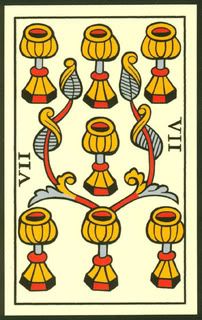
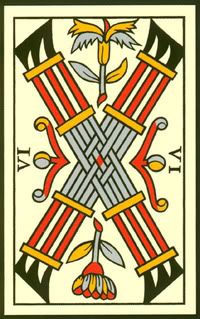
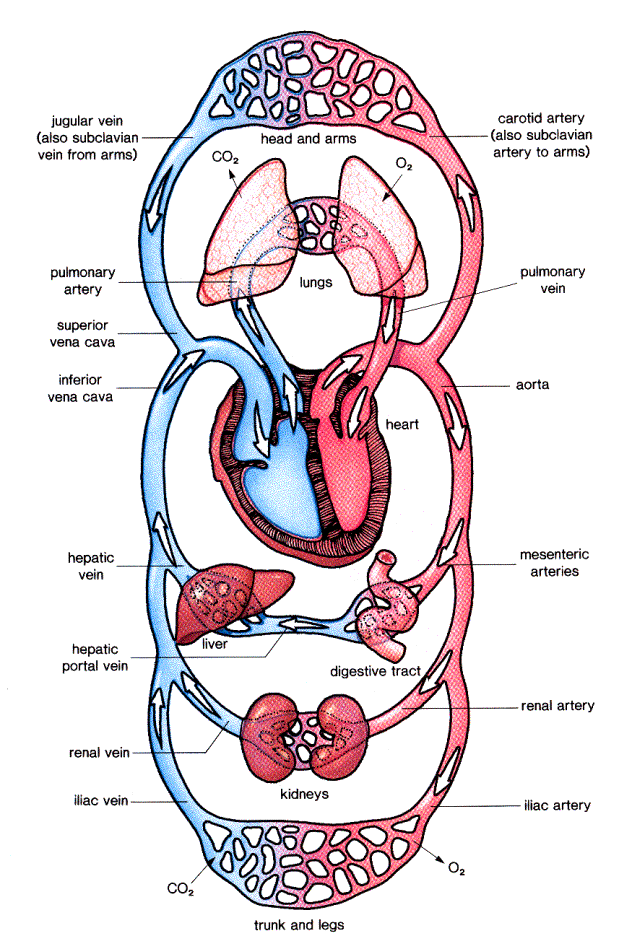
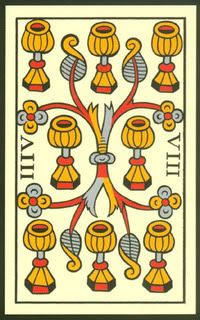
So we have a cup surrounded by identical cups and embraced by climbing vines; we have a heart within a system, but the circuit is interrupted, the arteries that are essential to its functioning never reach the mind. Pursuing those comforts of the heart without questioning why and blind faith in someone else's answers are a kind of brain-death; too often we're suffering from a sort of intellectual hypoxia, starving for a belief that will take our lives out of our own hands, euphoric with illusions that seem to lead to the promised land but instead lure us farther into ignorance.

Or we may see an individual nestled into the cushion of society, a church, a worldview built by someone else and controlled by a few, always at a remove from those they lead, always higher up the ladder. The cups arrange themselves into a grid, each indistinguishable from the other, vanishing into sameness.

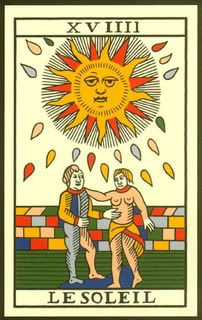
The wall behind the couple on the Sun card is another grid, and the man on the left seems almost to be in the process of merging with it, his leg turned to stone, frozen in an odd angular gesture like a figure carved in bas-relief. The woman appeals to him, but what is it that she wants? This could be a moment of choice; will he follow her, is following the only means of action he has? They regard each other warily, the way animals sniff out a stranger, each looking into the eyes of the other to see themselves. When we cultivate a pleasing image or act only according to someone else's whims and expectations, we're in danger of trapping ourselves within it, dancing in lockstep with no room for improvisation.

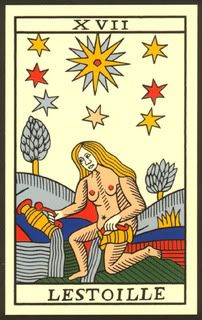
We're so desperate to inject our lives and our actions with meaning. If we can't find one we're happy to surrender our own will completely, if only someone will give us an answer and light up all the corners we can't see. It's not a question of rebellion purely for the sake of rebellion; any disenchanted teenager, clothed in the correct partisan uniform, worshipping at the altar of their various pop- and counter-culture idols can fail to accomplish anything with that. It's a matter of being constantly in the act of revision, reappearing to ourselves the way the Star reappears, never finished unburdening herself, emptying in order to fill.

Words aren't sacred, not our own, not anyone's. Rimbaud understood this when he dismantled his own work in "Alchemy of the Word", old poems he resurrected but appearing, as Graham Robb says, "curiously hobbled: syllables have dropped out like stones from an old wall.". And in the holes he pried open he saw through to a space where "From human praise, / From common urges / You free yourself / And fly off accordingly.".

9.20.2008

The union forever.

So often we are not at all what we thought we would be, are not, in fact, what we think we are. The problem seems to be one of twos; there is the self, and there is the projection of that self, almost always lost in translation, in the same way poets speak of never quite writing the poem they have in mind. There is what we can only understand as the self, which is a falsehood from the moment we recognize it because recognition requires us to separate from, and think of as other, whatever it is we're recognizing. There is something beyond that self, we can comprehend that with little effort, but there again is another divide, and all these splits and dualities build up in layers around us until they are absolutely opaque.

I'm quite sure even talking about it is a mistake. So often all we do is talk, and this particular subject is not a novel one. Language itself contributes to the problem, as Aldous Huxley tells us when he says, "To formulate and express the contents of the reduced awareness, man has invented and endlessly elaborated those symbol systems and implicit philosophies which we call languages." It's nothing but a code that we've invented and don't, ourselves, understand. Some can find a way to work within its constraints, wrapping themselves in those layers in order to make a daring escape, using a heap of language as a fulcrum to achieve a momentary lift.


This is one way, and it's as ambitious and elegant a use of the tools and weapons we have as any other, but it doesn't go far enough. Maybe a better way to at least begin to formulate an idea of how the divide came to be is to think a bit smaller. We can think of a letter, and a few numbers.

Aleph is the first letter of the Hebrew alphabet. There is some debate whether Aleph should be assigned to the number one or zero; it comes first, after all, but is last in presenting itself before God in the creation myth recounted in the Zohar. God chooses Bet, the second letter, to begin the Torah with, and Aleph is kept as the first letter, but with an important difference from the rest; it has no sound of its own---more properly it's the letter before sound, the preparation for sound, an inbreathing. For this reason it seems more logical to connect it with zero, which is the nullity that exists before we begin to count, the potential ability to define the size and shape of the palpable world.

Aleph is attributed to the element of Air, the breath and lungs in man, and the mind or thoughts of God. It's also associated with Kether, the first Sephiroth, in Kabbalah; this is the primal nothingness, the beginning of all that is, the void which may be glimpsed in the gaps of existence. It encompasses the beginning and end, and is present in all that unfolds in between. It's both part and whole, minimum and maximum, the source and completion, singular and myriad. This is all, of course, quite beyond the boundary of perception. It's at best unknowable, and usually unspeakable. To know it is to be distinct and separate from it, which is exactly the problem we're trying to solve when we think of it.

So zero is already perfect, in a state of unity with itself and the universe and the nothingness behind the universe, but since it is itself perfection and not separate from that perfection, it doesn't know that. Being the center itself, it can't know that it is the center. Potential wishes to realize itself, and seeds, by their nature, grow; we all have a desire to see our own reflection, become a being of matter. This is the beginning of consciousness, and this is how the break happens. The circle divides itself in half along a perfect line, and we have one. With it is born two--each number has in itself the next one, and every step can be traced back to the first one. When the circle splits, one (the fracture) and two (the halves) are born together.

One, and oneness, are an illusion, because oneness is not unity, it's the fracture, zero was the whole being. One lies between two severed halves, both uniting and separating them, as thin and unreal as a shadow, but still there. Nothing really keeps them apart, other than illusion. The veil of Maya, the ego which is another manifestation of one, whatever you want to call it, maintains the delusion of separation, keeps it in place, giving it the solidity of a concrete wall and strengthening it with the fear that is born of an ego that will do anything to maintain itself.

Two is, simply, duality, opposition, us and them, the always inscrutable Other. Zero was looking to know itself, but didn't realize that by breaking away from itself to look at its own face, it created the divide. Crowley came up with some bogus math telling us that 0=2, and this is valid, but I think what has to be done is to work in the opposite direction. The point isn't to go forward to two, but backward to zero--the journey isn't so much one of discovery, as it is one of recollection.

When we're caught in the illusion of two, we're stuck on the outside. Energy dissipates through the fracture. The self is a construct, built of stereotypes and imitation, it's literally the second-hand life. What is needed is a reversal, we need to go back to the unknowable and unspeakable, or so it appears to us from our side of the split. If we can go through that concrete wall that seems so solid, if what we see and hear stops being merely its corporeal self, it becomes a door to what can't be said. It is changed, and we are changed with it. The ego isn't judging, and putting things into their little boxes. When we are forced out of the rut, off the tracks, we can get a glimpse of the truth behind the surfaces. We're all stuck on the wheel, and maybe the idea is to turn the wheel backwards. And open the door, behind which waits the Aleph.

All of this is nothing more than a raft of symbols, which is not to say it's completely useless. The word "symbol" derives from the Greek symbolon, literally "to throw together". A symbolon was a piece of wood or porcelain that would be broken in two pieces, then held by two individuals that were about to be separated for a long time, and would eventually need something to recognize each other when reunited. A symbol is, therefore, a way of recognition, and the sign of a broken but repairable unity. Symbols give us the hope that reunion is possible.
All of this is nothing more than ornament, a fancy escutcheon around a keyhole we press an ear or an eye to. Where is the master key? If I find it, I'll let you know.


resurrected and revised. sometimes old emails are useful.

9.17.2008

What beast should I worship?


More from Season:

"A hyena you'll remain..."cries the demon that crowns me with many poppies. "Make for death with every appetite intact, with your egotism, and every capital sin."
Ah. It seems I have too many already: --But, dear Satan, I beg you not to look at me that way...
Science, the new nobility. Progress. The world turns. Why wouldn't it?...
But we don't leave. --We take the same roads, burdened with my vice, vice that since the age of reason has sunk its roots right into my side-- climbing skyward...
Out of the same desert, on the same night, my weary eyes forever stare at-- a silver star, but without setting life's Kings in motion, the three magi-- heart, soul, spirit. When, beyond mountains and rivers, will we embrace the birth of new endeavors, new wisdom, the departure of tyrants and demons, the end of superstition...

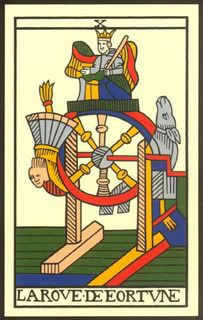
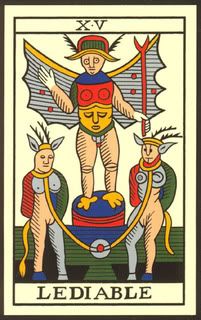
The wheel, how we are bound to it, how we struggle to escape it, and how it turns endlessly is an existential phenomenon that is itself endlessly turned over; medieval thinkers had their Rota Fortunae, and saṃsāra is a central tenet of Buddhism and Hindusim. In its paradoxical way, Buddhism teaches that the only means of liberation from the wheel is the wheel itself, and the Buddha's turning of it through the teachings of the Four Noble Truths.

I'm not a Buddhist, and one doesn't need to be in order to see that what we have here are images of release and captivity, suffering and attachment, desire and surrender, all spinning off from the wheel at the center.

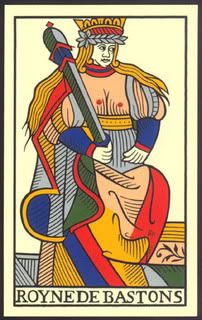
Normally I would read a sequence of cards from left to right, past to future, but these might also run backwards, or in a more circular manner: the queen appearing to turn away from the beckoning hand of the Devil, considering her apparently elevated status in the world, perhaps realizing that its foundations aren't as stable as they seem or that she is trapped by it, and finally coming back to the ground, unencumbered by symbols and unashamed to reveal herself, emptied of burdens and able to see to the roots of her own "Heart-mysteries there", as Yeats would have it. Read in this way we have a message of acceptance, and an acknowledgement of the need for liberation at the center of the human condition. Or we can imagine the four cards encircling the wheel itself, just as in the Carmina Burana it is captioned "I rule", "I have ruled", "I will rule", and "I am without rule" at its quadrants.

The danger, of course, is becoming resigned to this seemingly endless cycle, or getting stuck at one point in its circuit. There are as many ways to do this as there are ways to read these cards. In the same poem Yeats speaks of a woman who, "pity-crazed, had given her soul away, / But masterful Heaven had intervened to save it"; she is the Countess Cathleen of his mythic Irish history, who sells her soul to Satan to save the peasants suffering from famine and disease, but who escapes her fate when God grants her clemency for her sacrifice. She is one-dimensional, a "character isolated by a deed" in a morality play, resigned to dependence on the mercy of a distant deity. To see that we are are caught up in a circumstance sometimes called fate, to understand the nature of the beast, doesn't mean we should blindly hand ourselves over to it. This is the mistake of slavish devotion to religion--the perception of a world where we are helpless without the assistance of an unquestionable power outside ourselves, a world where everything is good or bad and there is no middle ground, where we are saved or damned on the strength of our adherence to a few reductive ideologies.

But what if we do read these cards from left to right, and swing the opposite way? If we see that the wheel turns regardless, and accept that this world is a manifestation of illusion, it's a small step to deciding that everything is immaterial, morality and the soul included. The Queen of Batons, instead of stripping down to the purity of the Star, or walking to her own martyrdom, may be seen as something akin to a Maenad, dancing away from the center and towards a dissolution that may appear to be liberating, but is in fact another kind of delusion. Worshipping destruction for its own sake, revoking responsibility in the pursuit of a release from the ego, or laying blame for our apparent suffering on the world's evils without looking for a remedy is as senseless as submitting to the will of a tyrannical ruler or a vengeful God. Even the Devil seems to want no part in it; he looks out from the card uneasily, and his captives are chained to nothing but each other, apparently complicit in their own bondage. The insanity plea, and "the devil made me do it", can be a bit too close to "thy will be done" for comfort.

We can define ourselves by what we lack, see ourselves as a skin wrapped around a void, choose to remain "in the foul rag-and-bone shop of the heart". We can do our best to secure our own release, and see through all the spin to the truth.
The word "beast" derives from the Greek therion, meaning "trap", and its diminutive, thera, may also mean "door". Somewhere between the two is the key.

9.13.2008

Rimbaud's questions.

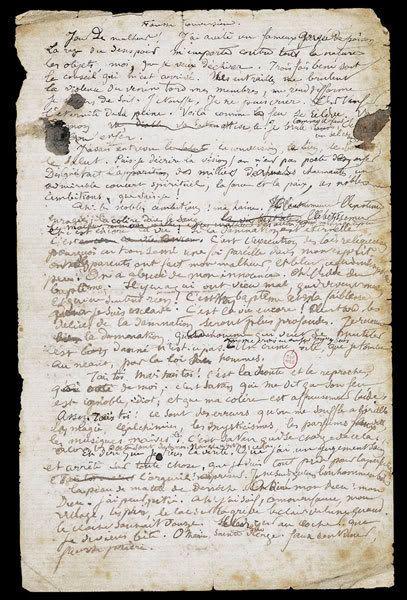
In the late summer of 1873 Arthur Rimbaud returned to his mother's farmhouse in the Ardennes countryside to complete the only work he chose to pursue publication of in his lifetime, A Season in Hell. According to the inevitable legend he locked himself in the attic, either under the influence of absinthe/hashish/opium/all of the above or suffering from their withdrawal (depending on who's telling the story), and in one great deluge purged himself of the sordid details of his life as a rebel poet, homosexual, criminal, homewrecker and near-murder victim. The most fanciful of the tales surrounding the composition of this work has him weeping and shouting into the late hours as he wrote, despairing over the fate of his jailed lover Paul Verlaine, and finally carving a cross surrounded by rays of light into the table where he wrote, renouncing his wicked ways and poetry itself, neatly tying up all the loose ends and walking away from his past into silence, forever.

Most of this is, of course, pure fantasy, as is the still-repeated legend of his return to his mother's house after Season's publication to burn every copy in the fireplace, as supposedly witnessed by his horrified sister. Most of the print-run he commissioned survived, as did a few of the manuscripts. Their numerous drafts show us a very deliberate and painstaking act of composition and a mind in complete possession of its faculties.


This was not the farewell to writing that it so fittingly appears to be. Rimbaud was not known for long goodbyes, and as Graham Robb writes, "The sheer biographical convenience of this scenario makes it deeply suspect. Literary works do not queue up patiently, waiting to write themselves into the chronology. The prose poems of the Illuminations overlap Une Saison en Enfer at either end."

Within this dense and elusive text we find a multitude of voices: a Faustian hustler who has finally been called to account for his debts; an illiterate savage caught in the juggernaut of colonizing white men, forced to submit to their clumsy attempts at edification; a cruel and careless "Infernal Bridegroom" trailed through the underworld by his long-suffering "Foolish Virgin"; a sinner begging forgiveness from a God he renounces in the same breath; a poet, who may or may not be Arthur Rimbaud, recounting his own history and that of his ancestors, finding them all, and himself above all, wanting for any redeeming qualities.

These voices may be read as allegories, brutal fables summarizing what it is to live in a state of disconnection from oneself, without a sense of direction, suspended in a sort of nihilistic purgatory. In this way they are "absolutely modern", as Rimbaud demanded of them and himself. Their cacophony echoes our own inner disputes, and how they bleed out into society at large. We cannot escape their grip, or their questions, as Rimbaud himself was well aware:

One of the voices,
always angelic,
--it was talking of me--
Sharply expressing itself:

--and Rimbaud's questions, what the voices say after the pregnant pause of that colon, remain relevant to us in ways even a self-proclaimed seer might not have known.

Rimbaud asks six questions in the section of Season titled "Bad Blood":

To whom shall I hire myself?
What beast should I worship?
What holy image are we attacking?
Which hearts shall I break?
What lie must I keep?
In what blood shall I walk?

Questions as singular as these surely deserve thinking about. So I'm going to do just that, using the allegories I find in my deck of cards and its own multitude of voices.

9.08.2008

Surely some revelation is at hand.

I understand that I've set myself a nearly impossible task. It would be easy to retreat into old methods of working; words considered only for their beauty, or their distressing lack of it, manipulating words just for the sake of artful adornment, the verbal equivalent of tasteful and inoffensive knick-knacks, shelves jammed with bits of china and crystal that fade into the background of our lives, that have no purpose, no longer seen the way anything too familiar is unseen. I have said that words are not enough, they don't go far enough, they are always constrained by their very nature. They are defined, in the sense that they have concrete meanings, and also in that they remain within their own clear, fixed borders. Between the Alpha and the Omega may be all that is, but by placing ourselves and everything we encounter within that concordance, by living a life reduced to an index of only what is explicable, we will never see what lies outside. I don't want to pin down all that should remain volatile.

The artist as saboteur has been a useful metaphor, but outside the insular world of high postmodernist theory tends to accomplish nothing other than building yet another barricade of words. One can live and die within the confines of a theory formulated more on shock-value than any real attempt to bring about liberation, whether personal or universal. There is no rebellion in adhering to manifestos, regardless of how innovative and clever their writers and followers imagine them to be. If we must apply any label at all to the transgressions against the routine that those in the vanguard commit, I prefer fugitive, and its dual meaning; one who escapes, armed and certainly dangerous, and one who is mutable, unable to be fixed within a frame.

I know a man who is this kind of fugitive, though he has never regarded himself in this way; maybe like the others out in front he has neither use for nor time to consider such a small detail. He reminds me of Yeats at his most visionary, the Yeats who wrote "The Second Coming"; a man who has the capacity to see the beginning and the end of the epoch we find ourselves stumbling through, and is furious to hasten it to that end; a man who is not cautious in his speech and rarely abides anyone who is in theirs; a man who is willing to cross the line, because he knows the act of crossing rips open a hole that exposes the truth so many others would prefer not to see.

Yeats ripped open that hole, and something appeared to him through it. He said, "I began to imagine, as always at my left side just out of the range of sight, a brazen winged beast which I associated with laughing, ecstatic destruction". This sort of subversive imagining was dismissed by the grey flannel crowd, including the didactic and mummified critic Yvor Winters, who remarked, "…we must face the fact that Yeats' attitude toward the beast is different from ours: we may find the beast terrifying, but Yeats finds him satisfying – he is Yeats' judgment upon all that we regard as civilized. Yeats approves of this kind of brutality." What Winters missed, or chose to ignore, is the reality of the nature of existence; destruction igniting creation, and the undeniable impermanence of both. It's not a question of approval. It's a certainty that we cannot deny, both brutal and exhilarating.

We keep looking for that hole, that line, but above all we must look, in ways that those who adhere to doctrines would not dare.

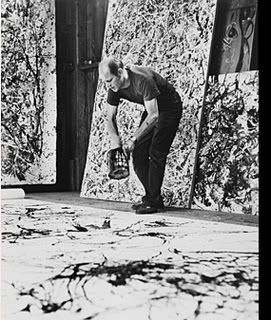
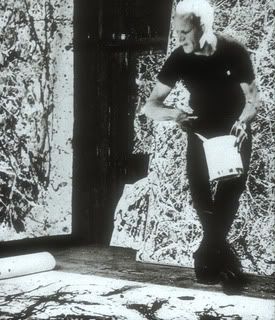
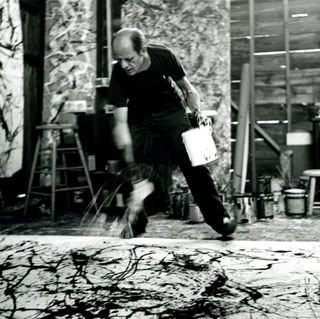
Years ago, this man I know went with me to a museum, and we stood and looked at this painting. I stayed at the prescribed respectful distance one is expected to in a museum, but he walked right up to it; one hand hovering inches from its surface, walking up and down its length, eyes roving across the web of enamel stuck with cigarette butts and ashes, bootprints around the edges, the weave of the canvas exposed where a jet of paint trailed off into scattered mist. He looked for a long time, and when he turned and walked back to me, the painting at his back like a great pair of wings, I wondered what it was that had been revealed to him, I wondered what Jackson Pollock had wanted to reveal and conceal as he danced his work into existence.


His vision, Pollock's vision, and Yeats' vision are not mine to know. And what we can glimpse of them is only the slag left in the furnace, the vortice streaming off a star as it dies, stripping down and readying itself to be created again.