Showing posts with label music. Show all posts

10.09.2008

Start again. Begin again.

I get stuck on things.

Songs and images, mostly, and most often the ones I get stuck on have a repetitive, insistent quality of their own; I find in them a sort of obsessive knot whose end I'd like to tease out. Somewhere between their repetition, and mine, I feel there must be something caught that wants to be revealed.

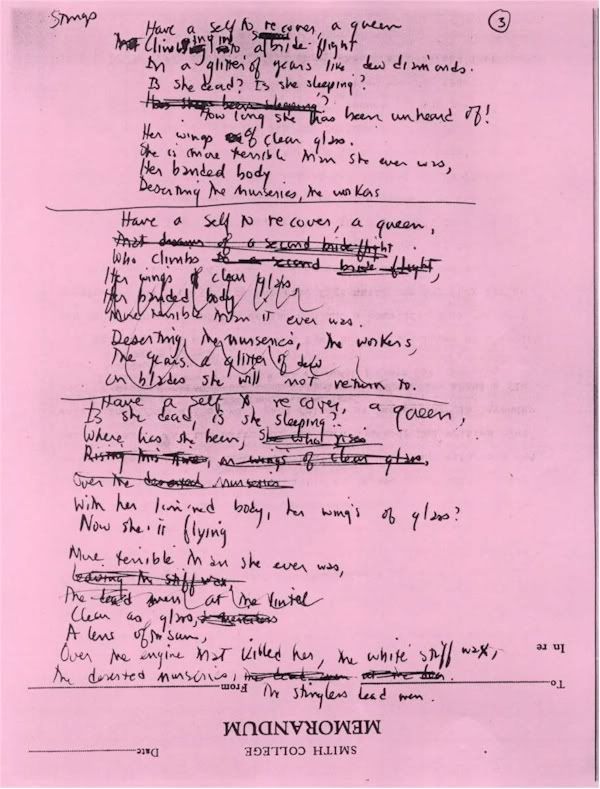
Right now it's one song, and in particular the guitar's circular, slashing motif; it makes me think of old manuscripts I've seen where the handwriting loops back on itself as revisions are endlessly worked over, where a thought can't be released until it's reached perfection or a stalemate, where there's an occasional pause as though breath were being drawn before the hand leaps back in and resumes the attack again.


I Might Be Wrong--Radiohead, live at Maida Vale

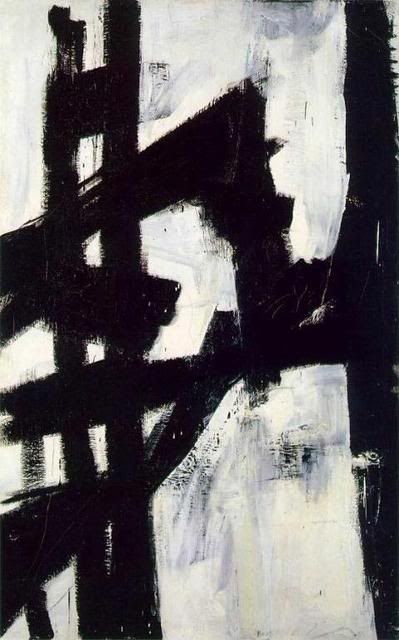
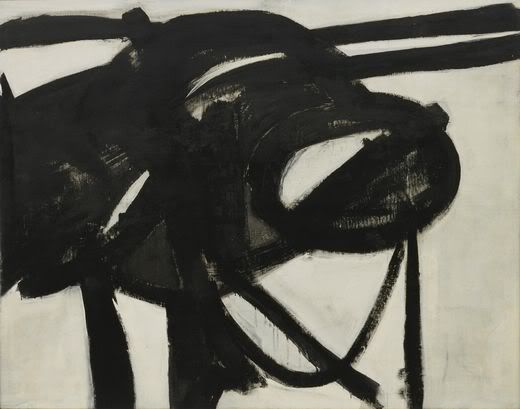
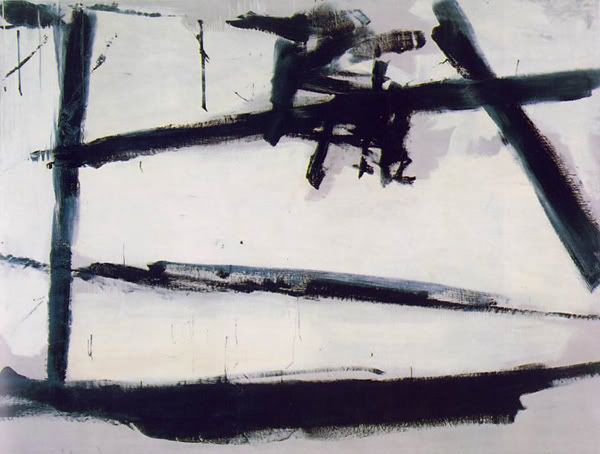
It reminds me of Franz Kline's black and white paintings; the same feeling of ferocity and economy.


Are there connections to be made when we look across genres this way, when the mind tugs on the end of that string and finds a never-ending series of knots in it? What happens within this kind of repetion, both the personal and artistic urges? It's something I'll be returning to.

9.11.2008

The right question.


Jeff Buckley--Haven't You Heard

The sound of the zeitgeist, putting aside the fact that it was recorded in 1996.
Who were you in 1996, and did you understand then what was coming? What will you do now that so often, and so infuriatingly, what comes and who you are aren't what you thought they would be?

I don't do politics here, and my brand of social commentary isn't of the naïf-in-scenester's-clothing or cutting satire variety. I don't have to cover any of these angles to know that we're in a fair bit of trouble, folks.

America is a palimpsest, as are we. Some of us decipher the underwriting, and some of us do the scraping. I know that we are being effaced in two ways: overwritten by a heavy-handed bureaucracy kissing the hem of religion and holding the trump card known as "patriotism"; and corroded to dust by our own indifference in the face of this.

I can remember who I was in 1996. The only question I can ask is which action to take--reveal what has been hidden beneath, or scour away what remains and start again from the ground?

9.03.2008

Want to disappear.


Well played, Jack White--well played.

I'm sure that in this moment Jack was simply expressing his frustration at the lack of rapport he felt with his audience, their lack of participation in the sweat and fury and fire he injects into every performance, but since I specialize in focusing on the moment, this one speaks to me of a larger issue I keep running up against.

Just when did it become the last word in social stances to be utterly unwilling to admit to any strong emotion, display anything other than a cool and detached disdain in all circumstances, or allow oneself to indulge in expressing enjoyment in front of (shock, horror) other people? For the hipster, the dismissive sneer and the blank stare are de rigeur. They coordinate beautifully with the Ikea nesting tables and sideboard, assembly instructions and unwavering apathy included.

I realize that I'm out of the loop. I realize that I am, in fact, terminally unhip. And this isn't an attempt to hark back to a less jaded, simpler time. It was always the mark of high culture and good breeding to cultivate the attitude of the hipster. As goes the self-appointed upper echelons of the trendsetters, those who define what nucleus of cool the hangers-on should cluster around, so goes the vegan dude in the drainpipe jeans and strategically unkempt hair at the 7-11.

In 1958 Jack Kerouac was invited to a symposium at Hunter College to debate the question "Is There a Beat Generation?". He was under the impression that he was there to read his poetry, and he was wrong. Instead he was asked to participate in poetry's dissection, to display himself for the bloodless academics, professors of anthropology and sociology, Village Voice reporters eager to bury the corpse and attend the birthing of the next literary happening. I can imagine Jack climbing that stage, a little the worse for drink, Jack who did nothing but feel a little too much for his own good and express that surge of feeling his whole life, I can see him sitting there with a glass of brandy, looking into the face of that sniffy disdain, wondering why.

Jack said,"And now there are two types of beat hipsters: the Cool, bearded, sitting without moving in cafes with their unfriendly girls dressed in black, who say nothing; and the Hot, crazy, talkative, mad shining eyes, running from bar to bar only to be ignored by the cool subterraneans. I guess I'm still with the hot ones. When I walk into a club playing jazz, I still want to shout." He also said, "You came here prepared to attack me."

We can be sure that this dichotomy between the hot and the cool has always existed, and the cool always looks to temper the hot, quenching it in the bath of the ironic gaze, not allowing it to bend into a new shape or send off such uncontrollable sparks. Jack must have known how apt the tag of "subterraneans" was--burying all that is spontaneous inside themselves, nothing freely given, and nothing transformative taken away. A few years before, in On the Road, he'd written, "You don't die enough to cry." Who decided that erasing all but the surface of this life is better than that death?

Two Jacks, wondering where everybody went.

8.29.2008

The way.

Some of us, a very few of us, are what the omnipresent "they" refer to as gifted. Whether an accident of nature, primed DNA waiting for an itchy trigger finger, a red flare in the frontal lobe, or a bestowal from an unknowable other, some of us are touched, some are the fire-bearers. It doesn't matter what you call it or where you think it comes from, when you brush up against it you see it for what it is, and if you're at all like me, you still carry a hope that some of it will cling to you as it passes.

Do the gifted know themselves to be so? This is a foolish question. Whatever it is that inhabits them, whatever they embody, doesn't have patience for questions. It knows that beauty is worthy of expression, and it also knows that going beyond beauty, putting beauty on the rack to see how much it can take, is a far better use of time. A supernal voice, scraping itself against the infernal, and in the tracks and grooves left behind by that abrasion a bit of shining debris, the glitter of grit, the imprint of an edge.

Imagine being possessed of a voice like that, and pressing yourself up against the ecstatic. How far would you take it? And having gone there, what would you see?


The Way Young Lovers Do--Jeff Buckley

8.28.2008

An interlude.

Sometimes during the course of my wanderings I stumble across a piece of video, a song, or an image that resonates with me for no reason at all. I'm always looking for a bit of meaning, I expect to find it, and sometimes meaning can be found in the view from the back of a cab driving through London, fingerprints on the glass, the screak of a fiddle, and a honest voice.

8.25.2008

The sound of a sinner.

The blues is the closest thing we have to an Ur-music. Captured on shellac discs etched in the back-rooms of general stores in prewar Texas, on a prison-farm in the swamps of Louisiana, in makeshift studios all over the Delta was the sound of man in extremis--supreme joy, crushing sorrow, mortal terror, spiritual loss and abandonment, bodily deprivation, the authoritative voice of one who has lived through all these and much worse, and the clear vision afforded those who remain always on the outside. What was captured on those discs in a place of fertile soil, grinding poverty, and not much else, was the spirit that urged the first men to stomp a foot on the ground to the rhythm of their hearts, to clap their hands in counterpoint, and to give voice to the experiences of that heart. The blues is a taproot plunging straight back to what is most alive in all of us; remembrance, forgetting, remembering why we so often choose to forget.

What we must forget now when we listen to the blues is the tired idea that the musicians who created it were noble savages, primitives, or illiterate sharecroppers artlessly plucking tunes on battered guitars they bartered for with their souls in the dead of night. This robs them of their art, their craft, and the genius they used to manipulate it--taking the tight form of the eight-, twelve-, or sixteen-bar blues and spinning out endless variations, expanding and contracting the rhythm and chord progressions, calling and responding to their fellow musicians with homages and outright thefts of language, and bringing to music a revolution in subject matter that resounds to this day. A blues song can be about anything, and is often about everything; two or three verses, a bridge and a turnaround that summarize an entire life, or the moment that completely changes it.

Just as Rimbaud stuffed his petrol bombs, street urchins, sheets of blood and priests in rotting cassocks into the corset of the alexandrine, working within the tradition on his way to undermining it, blues musicians took the events and fears and sorrows of their lives, so foreign to many of us now, and raised them to the level of universal truths. The bare facts of their everyday existences may be thin on the ground or altogether lost to history, but we can know them, and ourselves, through their work and the truth that work exposes to us; a truth beautiful yet unvarnished, beautiful because it is unvarnished.

Many of the recordings they left, despite the passage of time and their inevitable deterioration, retain an immediacy and intimacy that is almost shocking. Under the crackles, pops and hums that flaw even the best digital restorations we can hear the knock of the slide against the neck, the rattle of strings against steel. We can hear Robert Johnson turn his head away from the mic as he tells us about the mean things he's got on his mind, as if he looks over his shoulder and sees the end we know he'll meet approaching. He asks us to come into his kitchen, he asks us if we can hear the wind howling, he leans in close and makes it howl as he whispers in our ears.


Come On In My Kitchen--Robert Johnson

Other times his voice strains to the breaking point as the descending bassline dogs him, urging him on through a storm we can imagine so vividly, leaves littering the road and a woman his mind circles back to again and again.


Hellhound On My Trail--Robert Johnson

Some of these musicians lived long enough to be captured on film. Robert Johnson learned much of what he knew from Son House, part-time preacher, one-time inmate of Parchman Farm, full-time disjointed soul, a man whose music "is the centre of the blues experience and when he performs it is a corporeal thing, audience and singer become as one" according to Bob Groom; a man whose power never waned, even in old age, even in the moment when awareness and loss become one.


And in the end, the blues doesn't have to lean on the crutch of words to get the message across. Formless, and released from the possessive need to analyze and compartmentalize, to separate ourselves from what we feel and experience, it floats free. It, simply, is.


Dark Was The Night-Cold Was The Ground--Blind Willie Johnson

As Ralph Ellison said, "The blues is an art of ambiguity, an assertion of the irrepressibly human over all circumstances, whether created by others or by one's own human failing.". All men are fallen. Only a few can see beyond that to what lies on the other side, choose to walk through it with grace, and bring back to us what is found there.