Showing posts with label reality. Show all posts

10.23.2008

Silence is so accurate.

This according to Mark Rothko, who himself was rarely silent, especially in the matter of his own work; extremely conscious of his path of intent, he dedicated thousands of words and multiple manifestos to it, going so far as to insist upon the exact distance from which it should be viewed and the dimensions of the rooms in which it should be hung.

But he said this nonetheless, and on this we agree. There is no mistake in silence, and there is no mistaking what is meant when one chooses to maintain it. The act of speaking is riddled with errata, and the intent that inspires it is often a riddle to the speaker. What's worse is the awareness of being just wide of the mark with every attempt, the almost-right word we must hang our hopes on in the absence of the one we really meant. And what's worse, being unable to speak at all, or feeling an urgent need to speak and having nothing to say?

This is what preoccupies me. I've been silent, and so have remained errorless. But I'm not good at silence; I don't rest there willingly. Something itches, but I can't figure out where to scratch. I look around intently, I observe, in the hope that observation will provide me some insight into how others manage to speak, or at the very least that looking will satisfy the need to feel engaged with something outside my own silence. Occasionally I'm lucky enough to be in the company of others whose voices please me more than my own ever could; at those times I'm happy to listen, and there is some comfort in knowing that my silence is understood. But comfort is another state of being I find strange and disagreeable in large doses--too easy, the slip into a life of quietude and simple contentment, deciding that the work is finished, and nothing to do but wait for the long, slow scrape of years to bring an end to the waiting. It's probably a failing of mine to view things this way; people seem to do just fine following that very plan of action, that gradual yielding to inertia. But it's the just part of the equation that worries me.

And in the midst of all this hand-wringing I allow myself, the irony of the situation doesn't escape me, in that my intent consists of doing away with words entirely. Avoidance of them isn't the answer, nor is a the panicked flood that so often stems from the fear that silence is a kind of disappearance, that if we aren't heard, we've made no sound. Both of which are, a little bit, what I'm doing right now.

10.17.2008

And then I floated.

The question for me lately is one of strength. It's gone elsewhere, or I have, and in its absence I've been mutely considering how much time is wasted waiting for its return, and how to make use of the frustration I'm left holding like a wet book of matches. I locate my own worth in work, and more specifically in working with words, in what the mind can hope to do; the issue at hand is that the mind is dependant on the body for its subsistence.

I've always struggled with the reality of inhabiting a body. I'm certain there are people who live their lives without ever seeing this as a problem, but once you've made that distinction and seen the two as mutually exclusive entities, once a divide has been located and one half found superior, I don't think there's much chance of reuniting them. And when the body fails, the mind bound to it tends to follow.

That's where I am right now; right now, I'm an empty set. I also happen to be a child of the 90s, and our default emotion is rage, accompanied by a large helping of self-sabotage and an excruciating awareness of our own inadequacy.

The question, again, is one of finding a use for this. I'm working on that. Nothing is so honest as the body and its demands, unless it is a mind that realizes those demands must be met.

There will be a short intermission, and then we'll return to the program, already in progress.

10.15.2008

You'll have no need to exist / And wake up refreshed.

Recently I mentioned an individual who's been very influential in my life--a fellow seeker, and though his methods and the avenues of inquiry he travels diverge a bit from mine I believe we're both in pursuit of the same brand of truth. He knows things, and that's not a small achievement in this era of mindless surfaces and short attention-spans. He's always shared what he knows; his work focuses on the creation of a dialogue, and he'd like you to join him.

The conversation begins here. Please visit, listen, and contribute your comments and ideas. Tell us what you know, what you agree with, and what you think we're dead wrong about. There's a rapidly disappearing bottle of whiskey on the table, and smoking is allowed.

George Orwell tells us that "During times of universal deceit, telling the truth becomes a revolutionary act." It's time.

10.04.2008

A kind of Pythagorean terror.

In the last entry of her diary Virginia Woolf wrote:

"Everyone leaning against the wind, nipped & silenced. All pulp removed.

This windy corner. And Nessa is at Brighton, & I am imagining how it would be if we could infuse souls."

Four days later she walked into the River Ouse, her pockets full of stones, convinced that her work, her life, and her relationship with her sister Vanessa were irreparable failures. She believed she was again slipping away into the mental illness that had recurred throughout her life, and that she no longer had the strength to recover. She had saved herself several times already, it could be argued, and had been saved more often by the interventions of her husband, friends and family, and there is no telling why this time was different; maybe it was the threat of the German invasion of England, a very real threat in 1941, with serious implications for her own and her husband's well-being. She had completed the first revision of her last novel, Between the Acts, and at some point just after its completion she'd decided that the book was fundamentally flawed, and couldn't be fixed; she felt herself unable to write at all, telling her general practitioner, "I've lost all power over words, can't do a thing with them.", and maybe it was this loss of ability in the medium that had defined her life and brought her some feeling of independent success that she couldn't endure. She had begun to hear voices, she was sure she would become a burdensome invalid, and she must have thought she was doing what was best for everyone around her. The final letter she received from her sister might have convinced her this was so; this sister, her closest friend and ally, and at the same time her partner in a lifelong intellectual and emotional rivalry, writing to her that she must pull herself together in a time of great hardship for the whole country, and that she musn't create more worry to add to it.

She thanked her sister for this letter in the suicide note she left propped on her writing desk, and then she took a walk. And I haven't written this to praise, explain, or elegize what she did--it happens all the time, a person holding themselves up to the light and deciding that they can't cut something precious from the mess of inclusions they find, a ringing silence thickening the air to a bloodless, icy fist in which they're trapped. In a different context, earlier in her life, she had written, "I thought how unpleasant it is to be locked out; and I thought how it is worse, perhaps, to be locked in." The last hope of many, as it appeared to be hers, is to slip the bonds of the one life that feels so flawed from its very beginning and take on another, full in all the ways ours is found wanting, infinitely superior in its accomplishments and promise from the vantage-point of our own cramped, drafty corner. Virginia Woolf seemed to wish for this, appraising herself always in the light cast by her sister, whom she revered as a bountiful earth-mother, by her contemporaries in art and society, and by her predecessors.

We all do this. And if we do it enough these other lives crowd our own out of the picture entirely. We formulate a theory of the beautiful and worthy life using the examples laid out by others, and if we can't make an elegant proof of our own result from it, there is the fear that a life's work is lost. We're constantly running up against parts of ourselves that don't fit our view of what we should be, what we could have been, and the impossibility of reconciling the theory with the facts is often insupportable. This is the "Pythagorean terror" of Beckett's Three Dialogues; like Pythagoras, whose entire system of intellectual and spiritual belief was jeopardized by the discovery of irrational numbers, like Virginia Woolf, who said, "Odd how the creative power at once brings the whole universe to order" and couldn't support the loss of that ordering power, we can find ourselves left hollowed out and breathless as the foundations we've constructed are blown away.

I don't know the remedy for this, if there is one. I'm just as suceptible to this kind of terror as anyone else, and I've felt the products of my life, myself among them, to be a pale reflection of the creations of others who came before and did it better, and always not what they should have been. Even as I write this I feel it, and I'm reminded of so many others I know who are feeling it, and the killing punishments we dole out to ourselves, the mountains of work we've destroyed.
I'd like to find a way out of that corner where the light doesn't reach and we're "shadowed more and more darkly by a sense of invalidity, of inadequacy, of existence at the expense of all that it excludes, all that it blinds to." Maybe feeling around within that blindness for the outlines of a life where we can at least express that terror, understanding that there is little perfection to be found in any theory, is the best we can do.

9.27.2008

Climbing up a bloody great hill.

The President appeared on my tv the other night to deliver an address to the nation regarding the current financial crisis, and what action his administration and Congress plan to take to remedy it. In short, he wants us to do this.


Seems just a touch ironic when almost the whole of his two terms has been dedicated to persuasion through terror.

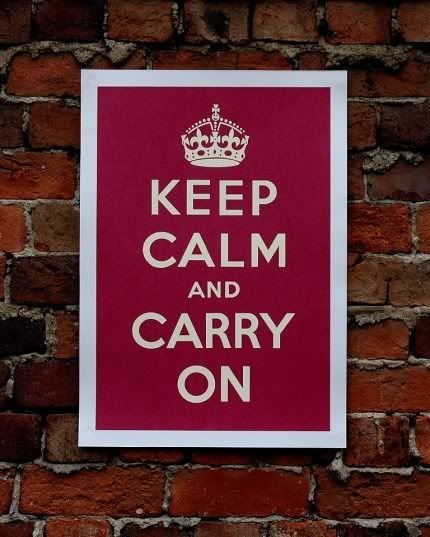
This poster was comissioned by the British government's Ministry of Information on the eve of their involvement in the war with Germany, and was meant to convey to the public an "attitude of mind" appropriate to the unknown and very dangerous situation they'd confront in the days and years ahead. Mr Bush is well-versed in the rallying cry of a well-timed piece of propaganda, and this country has, up to a point, been agreeable in the face of his decision to use its people as cannon-fodder. Our George, however, is not George VI; there is no Churchill on the horizon. And this is no longer a matter of stoicism and the acceptance of hardships with an eye to the greater good, and the surety that comes from suffering for the common cause. This is a matter of people's money, and I'm thinking it's not going to be a simple matter of telling everyone to buck up this time.

As I listened to the President I was aware of the fact that he wasn't talking to me. He was talking about mutual funds, mortgages, retirement accounts, and credit flow. I have none of those things, am in no danger of losing what I don't have, and so don't really figure into the equation. And it seems that more and more people might be joining me here among the ranks of those who really aren't a part of the fabric of American society. Clearly, to be of matter within it is to be tied to those slips of paper; when you take away a person's money, you take away their reality. Words are cheap to begin with, but even more so now. I'm wondering what words people will be speaking to themselves if they lose even a part of what they always assumed was so solid, if the institutions they believe in fail them. I'm wondering how much they can lose and still function, and what will happen once a little too much is taken away.

In Journey to the End of the Night, Louis-Ferdinand Céline writes about his experiences as a calvary officer in World War One. Early in the story his regiment is shelled by the Germans, his colonel is killed, and he is seriously wounded; somehow he escapes and makes his way to the rear, where he's put to work at a ration distribution point. He's just seen most of his fellow soldiers slaughtered, but remains full of his usual apocalyptic joie de vivre, until he's confronted with the sight of the regiment's butchers at work: "The squadrons were fighting tooth and nail over the innards, especially the kidneys, and all around them swarms of flies such as one sees only on such occasions, as self-important and musical as little birds.
Blood and more blood, everywhere, all over the grass, in sluggish confluent puddles, looking for a congenial slope."
And it's this moment, finally, that proves too much for him; he faints dead away.

It's interesting how we can become accustomed to almost anything, how we can ignore what horrifies us for so long, function despite the untenable situation staring us in the face, right up to the moment when it changes context and we see it as if anew, through defenseless eyes. It's interesting what happens to people, and what they'll do to survive, when that last, small piece of belief is taken from them.