Showing posts with label poetry. Show all posts

9.13.2008

Rimbaud's questions.

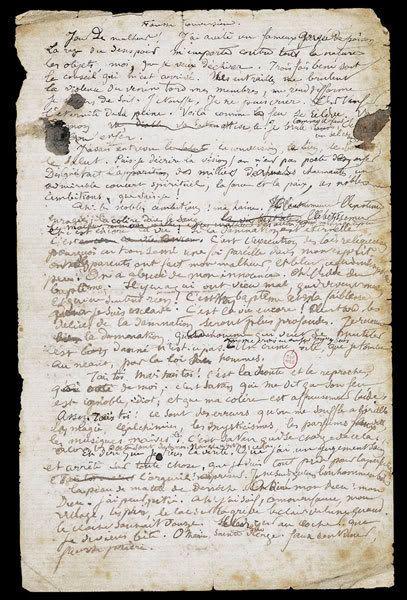
In the late summer of 1873 Arthur Rimbaud returned to his mother's farmhouse in the Ardennes countryside to complete the only work he chose to pursue publication of in his lifetime, A Season in Hell. According to the inevitable legend he locked himself in the attic, either under the influence of absinthe/hashish/opium/all of the above or suffering from their withdrawal (depending on who's telling the story), and in one great deluge purged himself of the sordid details of his life as a rebel poet, homosexual, criminal, homewrecker and near-murder victim. The most fanciful of the tales surrounding the composition of this work has him weeping and shouting into the late hours as he wrote, despairing over the fate of his jailed lover Paul Verlaine, and finally carving a cross surrounded by rays of light into the table where he wrote, renouncing his wicked ways and poetry itself, neatly tying up all the loose ends and walking away from his past into silence, forever.

Most of this is, of course, pure fantasy, as is the still-repeated legend of his return to his mother's house after Season's publication to burn every copy in the fireplace, as supposedly witnessed by his horrified sister. Most of the print-run he commissioned survived, as did a few of the manuscripts. Their numerous drafts show us a very deliberate and painstaking act of composition and a mind in complete possession of its faculties.

This was not the farewell to writing that it so fittingly appears to be. Rimbaud was not known for long goodbyes, and as Graham Robb writes, "The sheer biographical convenience of this scenario makes it deeply suspect. Literary works do not queue up patiently, waiting to write themselves into the chronology. The prose poems of the Illuminations overlap Une Saison en Enfer at either end."

Within this dense and elusive text we find a multitude of voices: a Faustian hustler who has finally been called to account for his debts; an illiterate savage caught in the juggernaut of colonizing white men, forced to submit to their clumsy attempts at edification; a cruel and careless "Infernal Bridegroom" trailed through the underworld by his long-suffering "Foolish Virgin"; a sinner begging forgiveness from a God he renounces in the same breath; a poet, who may or may not be Arthur Rimbaud, recounting his own history and that of his ancestors, finding them all, and himself above all, wanting for any redeeming qualities.

These voices may be read as allegories, brutal fables summarizing what it is to live in a state of disconnection from oneself, without a sense of direction, suspended in a sort of nihilistic purgatory. In this way they are "absolutely modern", as Rimbaud demanded of them and himself. Their cacophony echoes our own inner disputes, and how they bleed out into society at large. We cannot escape their grip, or their questions, as Rimbaud himself was well aware:

One of the voices,
always angelic,
--it was talking of me--
Sharply expressing itself:

--and Rimbaud's questions, what the voices say after the pregnant pause of that colon, remain relevant to us in ways even a self-proclaimed seer might not have known.

Rimbaud asks six questions in the section of Season titled "Bad Blood":

To whom shall I hire myself?
What beast should I worship?
What holy image are we attacking?
Which hearts shall I break?
What lie must I keep?
In what blood shall I walk?

Questions as singular as these surely deserve thinking about. So I'm going to do just that, using the allegories I find in my deck of cards and its own multitude of voices.

9.05.2008

The night is dark / and the stars tremble in reply.

I believe in synchronicity. Whether finding it is the result of always being on the hunt, or if the belief itself makes it happen, there are connections to be made, small glimmers we can stumble upon that allow us to view that ineffable thing I keep talking about. Or is it what remains when things are pushed aside? The simple part is knowing that it happens, and seeing it when it does. The difficult part is understanding what has made itself present to our sight, and getting the message.

I stumbled upon a fragment of a poem by Edith Södergran that I'd never read, and it wanted to say something to me; "I long for the land that is not, / for everything that is I am weary of craving.". I wanted to think about where this land might be, being fairly certain I was also longing for it, being a little less certain of its location, and all too aware that a craving of one type or another is never far over the horizon. So I looked at my cards.


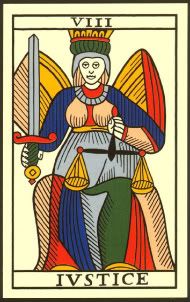
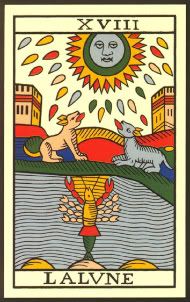
A small creature, who seems trapped underground or underwater, tries to break the surface. Arrows point to a place of crossing at the heart of the matter, behind which lies a straightforward path. A winged woman stares me in the face.

Crayfish are scavengers, bottom-feeders. They tend to dig trenches and burrow into the bottom of the river, they need a shelter to hide in, they shy away by nature. This is all well and good if one is a crayfish, but the rest of us might start feeling a little smothered, we might want something a little freer, a better way to find what feeds us. Up there in the open air the dogs seem to be having a great time, howling at the moon, feasting on its light, but are they a threat to something small, is there a wolf at the door if one decides to emerge from a safe place? The moon has a kind look about her, but she hides behind the radiance she excites the dogs with; she is veiled and inscrutable, heavy-lidded, and the crayfish waits in a little pool of light. Is he frightened? Edith herself seemed frightened by what might be found there in the dark, or what we cannot see when we look out into it:

When night comes
I stand on the steps and listen,
stars swarm in the yard
and I stand in the dark.
Listen, a star fell with a clang!
Don’t go out in the grass with bare feet;
my yard is full of shards.

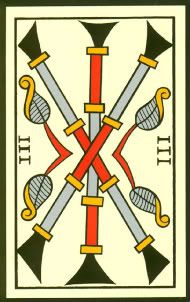
And not seeing, or willing oneself not to see, seems to be part of the story the cards tell. The vines in the three of batons point to a red X at the center--what is hidden from view, what integral part of the message has been missed? When a webpage doesn't load properly, the images are replaced by an X just like this, and we don't receive all the information we were looking for. Something has been blocked out, and the batons seem to diverge from it, pushing against the frame of the card. Are they thinking of escape as well? Or should they backtrack to what has been overlooked, find a new path to begin the voyage out?

Edith Södergran was on the front lines of modernism. She says, later in the same poem where I found my fragment, "My life was a hot illusion", but if she was deceived, it didn't prevent her from reaching that land she spoke of--clearsighted, shedding the ridicule of her peers, she went back to the heart of her own vision, and spoke it without hesitation. The face of the moon, so mysterious and distant, is stripped of her veils, and Justice seems to ask us to see what she sees. She has removed her blindfold, she is prepared to weigh everything that comes to her attention and cut out what is superfluous. She reminds me of the tree of life, and its two pillars of Mercy and Strength. She might be wearing the crown of Kether, understanding all that we cannot see if we remain in the dark, hiding in the little pool of reflected light, if we don't go back to the center where our own vision starts. Or is she the keeper of everything we crave?

I don't believe in asking questions that can be easily answered. For me, finding answers is not the reason I look at the cards, or read poetry, and there are no answers as to what may be found beyond them. But by addressing to them the questions that they provoke in us, a space in the mind where change happens may be cleared. The yard may be full of those treacherous shards, but we may walk among them with an intent, and an eye to what they kindle as they land.