9.08.2008

Surely some revelation is at hand.

I understand that I've set myself a nearly impossible task. It would be easy to retreat into old methods of working; words considered only for their beauty, or their distressing lack of it, manipulating words just for the sake of artful adornment, the verbal equivalent of tasteful and inoffensive knick-knacks, shelves jammed with bits of china and crystal that fade into the background of our lives, that have no purpose, no longer seen the way anything too familiar is unseen. I have said that words are not enough, they don't go far enough, they are always constrained by their very nature. They are defined, in the sense that they have concrete meanings, and also in that they remain within their own clear, fixed borders. Between the Alpha and the Omega may be all that is, but by placing ourselves and everything we encounter within that concordance, by living a life reduced to an index of only what is explicable, we will never see what lies outside. I don't want to pin down all that should remain volatile.

The artist as saboteur has been a useful metaphor, but outside the insular world of high postmodernist theory tends to accomplish nothing other than building yet another barricade of words. One can live and die within the confines of a theory formulated more on shock-value than any real attempt to bring about liberation, whether personal or universal. There is no rebellion in adhering to manifestos, regardless of how innovative and clever their writers and followers imagine them to be. If we must apply any label at all to the transgressions against the routine that those in the vanguard commit, I prefer fugitive, and its dual meaning; one who escapes, armed and certainly dangerous, and one who is mutable, unable to be fixed within a frame.

I know a man who is this kind of fugitive, though he has never regarded himself in this way; maybe like the others out in front he has neither use for nor time to consider such a small detail. He reminds me of Yeats at his most visionary, the Yeats who wrote "The Second Coming"; a man who has the capacity to see the beginning and the end of the epoch we find ourselves stumbling through, and is furious to hasten it to that end; a man who is not cautious in his speech and rarely abides anyone who is in theirs; a man who is willing to cross the line, because he knows the act of crossing rips open a hole that exposes the truth so many others would prefer not to see.

Yeats ripped open that hole, and something appeared to him through it. He said, "I began to imagine, as always at my left side just out of the range of sight, a brazen winged beast which I associated with laughing, ecstatic destruction". This sort of subversive imagining was dismissed by the grey flannel crowd, including the didactic and mummified critic Yvor Winters, who remarked, "…we must face the fact that Yeats' attitude toward the beast is different from ours: we may find the beast terrifying, but Yeats finds him satisfying – he is Yeats' judgment upon all that we regard as civilized. Yeats approves of this kind of brutality." What Winters missed, or chose to ignore, is the reality of the nature of existence; destruction igniting creation, and the undeniable impermanence of both. It's not a question of approval. It's a certainty that we cannot deny, both brutal and exhilarating.

We keep looking for that hole, that line, but above all we must look, in ways that those who adhere to doctrines would not dare.

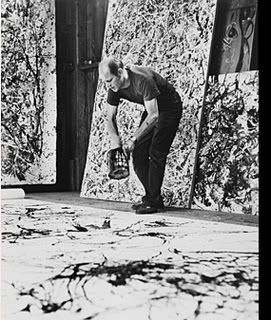
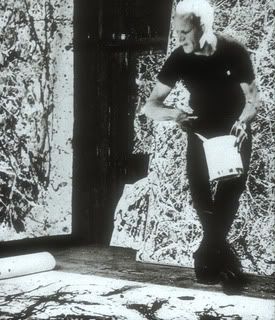
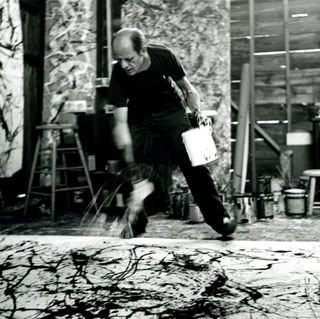
Years ago, this man I know went with me to a museum, and we stood and looked at this painting. I stayed at the prescribed respectful distance one is expected to in a museum, but he walked right up to it; one hand hovering inches from its surface, walking up and down its length, eyes roving across the web of enamel stuck with cigarette butts and ashes, bootprints around the edges, the weave of the canvas exposed where a jet of paint trailed off into scattered mist. He looked for a long time, and when he turned and walked back to me, the painting at his back like a great pair of wings, I wondered what it was that had been revealed to him, I wondered what Jackson Pollock had wanted to reveal and conceal as he danced his work into existence.


His vision, Pollock's vision, and Yeats' vision are not mine to know. And what we can glimpse of them is only the slag left in the furnace, the vortice streaming off a star as it dies, stripping down and readying itself to be created again.

9.05.2008

The night is dark / and the stars tremble in reply.

I believe in synchronicity. Whether finding it is the result of always being on the hunt, or if the belief itself makes it happen, there are connections to be made, small glimmers we can stumble upon that allow us to view that ineffable thing I keep talking about. Or is it what remains when things are pushed aside? The simple part is knowing that it happens, and seeing it when it does. The difficult part is understanding what has made itself present to our sight, and getting the message.

I stumbled upon a fragment of a poem by Edith Södergran that I'd never read, and it wanted to say something to me; "I long for the land that is not, / for everything that is I am weary of craving.". I wanted to think about where this land might be, being fairly certain I was also longing for it, being a little less certain of its location, and all too aware that a craving of one type or another is never far over the horizon. So I looked at my cards.


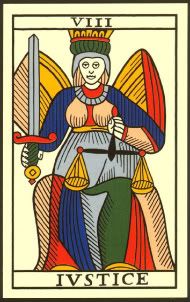
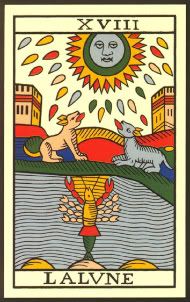
A small creature, who seems trapped underground or underwater, tries to break the surface. Arrows point to a place of crossing at the heart of the matter, behind which lies a straightforward path. A winged woman stares me in the face.

Crayfish are scavengers, bottom-feeders. They tend to dig trenches and burrow into the bottom of the river, they need a shelter to hide in, they shy away by nature. This is all well and good if one is a crayfish, but the rest of us might start feeling a little smothered, we might want something a little freer, a better way to find what feeds us. Up there in the open air the dogs seem to be having a great time, howling at the moon, feasting on its light, but are they a threat to something small, is there a wolf at the door if one decides to emerge from a safe place? The moon has a kind look about her, but she hides behind the radiance she excites the dogs with; she is veiled and inscrutable, heavy-lidded, and the crayfish waits in a little pool of light. Is he frightened? Edith herself seemed frightened by what might be found there in the dark, or what we cannot see when we look out into it:

When night comes
I stand on the steps and listen,
stars swarm in the yard
and I stand in the dark.
Listen, a star fell with a clang!
Don’t go out in the grass with bare feet;
my yard is full of shards.

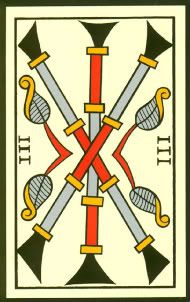
And not seeing, or willing oneself not to see, seems to be part of the story the cards tell. The vines in the three of batons point to a red X at the center--what is hidden from view, what integral part of the message has been missed? When a webpage doesn't load properly, the images are replaced by an X just like this, and we don't receive all the information we were looking for. Something has been blocked out, and the batons seem to diverge from it, pushing against the frame of the card. Are they thinking of escape as well? Or should they backtrack to what has been overlooked, find a new path to begin the voyage out?

Edith Södergran was on the front lines of modernism. She says, later in the same poem where I found my fragment, "My life was a hot illusion", but if she was deceived, it didn't prevent her from reaching that land she spoke of--clearsighted, shedding the ridicule of her peers, she went back to the heart of her own vision, and spoke it without hesitation. The face of the moon, so mysterious and distant, is stripped of her veils, and Justice seems to ask us to see what she sees. She has removed her blindfold, she is prepared to weigh everything that comes to her attention and cut out what is superfluous. She reminds me of the tree of life, and its two pillars of Mercy and Strength. She might be wearing the crown of Kether, understanding all that we cannot see if we remain in the dark, hiding in the little pool of reflected light, if we don't go back to the center where our own vision starts. Or is she the keeper of everything we crave?

I don't believe in asking questions that can be easily answered. For me, finding answers is not the reason I look at the cards, or read poetry, and there are no answers as to what may be found beyond them. But by addressing to them the questions that they provoke in us, a space in the mind where change happens may be cleared. The yard may be full of those treacherous shards, but we may walk among them with an intent, and an eye to what they kindle as they land.

9.03.2008

Want to disappear.


Well played, Jack White--well played.

I'm sure that in this moment Jack was simply expressing his frustration at the lack of rapport he felt with his audience, their lack of participation in the sweat and fury and fire he injects into every performance, but since I specialize in focusing on the moment, this one speaks to me of a larger issue I keep running up against.

Just when did it become the last word in social stances to be utterly unwilling to admit to any strong emotion, display anything other than a cool and detached disdain in all circumstances, or allow oneself to indulge in expressing enjoyment in front of (shock, horror) other people? For the hipster, the dismissive sneer and the blank stare are de rigeur. They coordinate beautifully with the Ikea nesting tables and sideboard, assembly instructions and unwavering apathy included.

I realize that I'm out of the loop. I realize that I am, in fact, terminally unhip. And this isn't an attempt to hark back to a less jaded, simpler time. It was always the mark of high culture and good breeding to cultivate the attitude of the hipster. As goes the self-appointed upper echelons of the trendsetters, those who define what nucleus of cool the hangers-on should cluster around, so goes the vegan dude in the drainpipe jeans and strategically unkempt hair at the 7-11.

In 1958 Jack Kerouac was invited to a symposium at Hunter College to debate the question "Is There a Beat Generation?". He was under the impression that he was there to read his poetry, and he was wrong. Instead he was asked to participate in poetry's dissection, to display himself for the bloodless academics, professors of anthropology and sociology, Village Voice reporters eager to bury the corpse and attend the birthing of the next literary happening. I can imagine Jack climbing that stage, a little the worse for drink, Jack who did nothing but feel a little too much for his own good and express that surge of feeling his whole life, I can see him sitting there with a glass of brandy, looking into the face of that sniffy disdain, wondering why.

Jack said,"And now there are two types of beat hipsters: the Cool, bearded, sitting without moving in cafes with their unfriendly girls dressed in black, who say nothing; and the Hot, crazy, talkative, mad shining eyes, running from bar to bar only to be ignored by the cool subterraneans. I guess I'm still with the hot ones. When I walk into a club playing jazz, I still want to shout." He also said, "You came here prepared to attack me."

We can be sure that this dichotomy between the hot and the cool has always existed, and the cool always looks to temper the hot, quenching it in the bath of the ironic gaze, not allowing it to bend into a new shape or send off such uncontrollable sparks. Jack must have known how apt the tag of "subterraneans" was--burying all that is spontaneous inside themselves, nothing freely given, and nothing transformative taken away. A few years before, in On the Road, he'd written, "You don't die enough to cry." Who decided that erasing all but the surface of this life is better than that death?

Two Jacks, wondering where everybody went.

9.01.2008

Seeing.

Everything is waiting for us to see it.
Anything may be read.

I'm speaking of seeing and reading in the sense of divination--not as a method of fortune-telling, nor of predicting the future, but of opening oneself to messages looking for a destination. Everyone has the potential to be a receiver of messages, and most have experienced spontaneous divination; anyone who has been profoundly moved by a work of art in a way they can't explain, felt that the lyrics of a random song on the radio were speaking to them in the moment, found a passage in a book that provides an answer to an unspoken question. Often these messages are wordless revelations--a door cracks open, and we can walk through it under our own power. Disparate pieces of a puzzle suddenly lock together. Maybe it's a divine proto-language we've tapped into, or the sudden flap of a wing, a vision descending.

We may also employ any number of tools to invite this way of seeing. Sortilege, or the casting of lots, may be the oldest form of divination; stones, bones or wax in a bowl of water, anything can be thrown down and a reading found in the spaces. The practitioners of this method took Mercury as their patron in antiquity, and the element of mercury seems to be a wholly appropriate metaphor for the act itself--its form and the meaning found there relevant only to the moment, ever-changing, impossible to pin down.

All of us have a natural affinity for images--they are the most direct form of communication, understandable at a glance, a shortcut around the gridlock our minds might encounter when we try to express ourselves with words. Images can also allow us to communicate more directly with ourselves as well. I read tarot, or rather I look at tarot and try to see what it wants to say to me, and listen to how it speaks. I use the Noblet Marseille, a restoration of a Parisian deck printed in 1650, and this is unimportant aside from the fact that the Marseille deck is free of any esoteric overlays; the history and iconography of the Marseille and its variants is a fascinating and hotly debated subject, but if we pull it out from under the weight of its history it may be read as pure imagery, and becomes a hotline to insights--literally a way of seeing into ourselves and the situation at hand.

The method I use with the Noblet is the creation of Enrique Enriquez, and he calls it Eye Rhyme. I won't explain it here, it should be read in his own words, understood using his examples. I believe it was this way of seeing, not just the cards but an entire life and its content, that Allen Ginsberg was speaking of in his famous aphorism, "first thought, best thought". This understanding of the visionary state is one aspect of what drove Rimbaud to write the second of his "Voyant" letters, where he says, "This much is clear: I'm around for the hatching of my thought: I watch it, I listen to it: I release a stroke from the bow: the symphony makes its rumblings in the depths, or leaps fully formed onto the stage.". And later, in the same letter, "This language will be of the soul, for the soul, encompassing everything, scents, sounds, colors, thought latching onto thought and pulling.". The language he speaks of may be read by looking at the Marseille, where visions indeed act out our personal dramas again and again.

I can toss a few cards onto the floor and, like stones in a riverbed, follow their various paths to any number of ends. I can see how the figures on the trumps and courts regard each other, I can listen in on their conversations. The point in all of this is, simply, to look.

Look at the Bateleur, the first Trump:

Photobucket
As I write this he appears to me in the guise of legerdemain, and also as the seer I'm speaking of--he looks over his shoulder to the left, the past, perhaps engaged in memory and what can be found there, manipulating the mysterious objects on his table; is he casting lots, is he a practitioner of sortilege? The name he conjures for me, "legerdemain", and the word "sortilege" itself share the same root--leger, meaning light, or quick. Mercurial.

Look at the second trump, the Papesse:

Photobucket

She sits quietly, an open book in her lap. Has she found an answer she didn't know to ask there? She also looks to the left, but her manner suggests something altogether different from the gaze of the Bateleur, something other--is she a visionary as well? Is this the moment of visitation?

The point is to see. Anais Nin said, "We don't see things as they are, we see things as we are.". The tools are there for us to use, the tools are everywhere at hand.