10.09.2008

Start again. Begin again.

I get stuck on things.

Songs and images, mostly, and most often the ones I get stuck on have a repetitive, insistent quality of their own; I find in them a sort of obsessive knot whose end I'd like to tease out. Somewhere between their repetition, and mine, I feel there must be something caught that wants to be revealed.

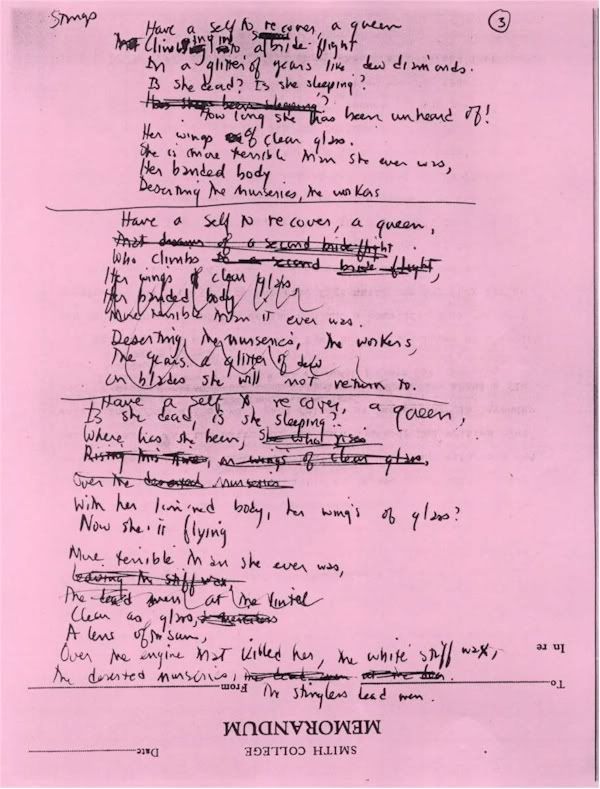
Right now it's one song, and in particular the guitar's circular, slashing motif; it makes me think of old manuscripts I've seen where the handwriting loops back on itself as revisions are endlessly worked over, where a thought can't be released until it's reached perfection or a stalemate, where there's an occasional pause as though breath were being drawn before the hand leaps back in and resumes the attack again.


I Might Be Wrong--Radiohead, live at Maida Vale

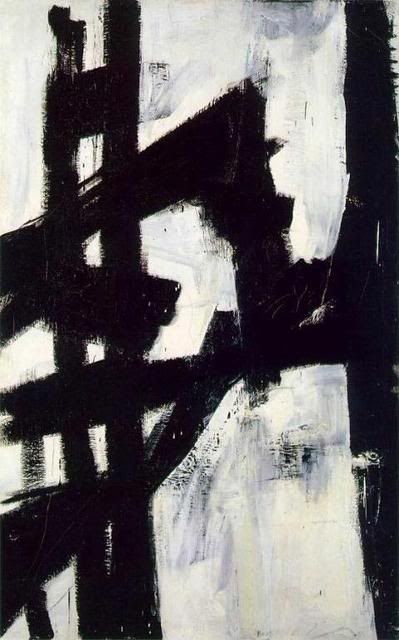
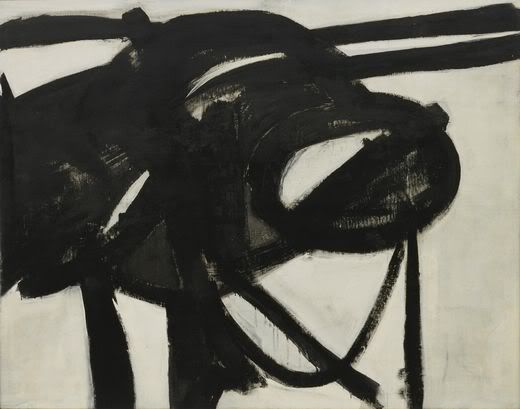
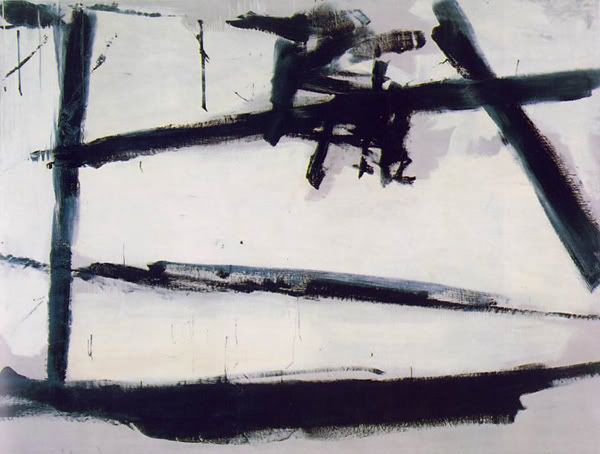
It reminds me of Franz Kline's black and white paintings; the same feeling of ferocity and economy.


Are there connections to be made when we look across genres this way, when the mind tugs on the end of that string and finds a never-ending series of knots in it? What happens within this kind of repetion, both the personal and artistic urges? It's something I'll be returning to.

10.04.2008

A kind of Pythagorean terror.

In the last entry of her diary Virginia Woolf wrote:

"Everyone leaning against the wind, nipped & silenced. All pulp removed.

This windy corner. And Nessa is at Brighton, & I am imagining how it would be if we could infuse souls."

Four days later she walked into the River Ouse, her pockets full of stones, convinced that her work, her life, and her relationship with her sister Vanessa were irreparable failures. She believed she was again slipping away into the mental illness that had recurred throughout her life, and that she no longer had the strength to recover. She had saved herself several times already, it could be argued, and had been saved more often by the interventions of her husband, friends and family, and there is no telling why this time was different; maybe it was the threat of the German invasion of England, a very real threat in 1941, with serious implications for her own and her husband's well-being. She had completed the first revision of her last novel, Between the Acts, and at some point just after its completion she'd decided that the book was fundamentally flawed, and couldn't be fixed; she felt herself unable to write at all, telling her general practitioner, "I've lost all power over words, can't do a thing with them.", and maybe it was this loss of ability in the medium that had defined her life and brought her some feeling of independent success that she couldn't endure. She had begun to hear voices, she was sure she would become a burdensome invalid, and she must have thought she was doing what was best for everyone around her. The final letter she received from her sister might have convinced her this was so; this sister, her closest friend and ally, and at the same time her partner in a lifelong intellectual and emotional rivalry, writing to her that she must pull herself together in a time of great hardship for the whole country, and that she musn't create more worry to add to it.

She thanked her sister for this letter in the suicide note she left propped on her writing desk, and then she took a walk. And I haven't written this to praise, explain, or elegize what she did--it happens all the time, a person holding themselves up to the light and deciding that they can't cut something precious from the mess of inclusions they find, a ringing silence thickening the air to a bloodless, icy fist in which they're trapped. In a different context, earlier in her life, she had written, "I thought how unpleasant it is to be locked out; and I thought how it is worse, perhaps, to be locked in." The last hope of many, as it appeared to be hers, is to slip the bonds of the one life that feels so flawed from its very beginning and take on another, full in all the ways ours is found wanting, infinitely superior in its accomplishments and promise from the vantage-point of our own cramped, drafty corner. Virginia Woolf seemed to wish for this, appraising herself always in the light cast by her sister, whom she revered as a bountiful earth-mother, by her contemporaries in art and society, and by her predecessors.

We all do this. And if we do it enough these other lives crowd our own out of the picture entirely. We formulate a theory of the beautiful and worthy life using the examples laid out by others, and if we can't make an elegant proof of our own result from it, there is the fear that a life's work is lost. We're constantly running up against parts of ourselves that don't fit our view of what we should be, what we could have been, and the impossibility of reconciling the theory with the facts is often insupportable. This is the "Pythagorean terror" of Beckett's Three Dialogues; like Pythagoras, whose entire system of intellectual and spiritual belief was jeopardized by the discovery of irrational numbers, like Virginia Woolf, who said, "Odd how the creative power at once brings the whole universe to order" and couldn't support the loss of that ordering power, we can find ourselves left hollowed out and breathless as the foundations we've constructed are blown away.

I don't know the remedy for this, if there is one. I'm just as suceptible to this kind of terror as anyone else, and I've felt the products of my life, myself among them, to be a pale reflection of the creations of others who came before and did it better, and always not what they should have been. Even as I write this I feel it, and I'm reminded of so many others I know who are feeling it, and the killing punishments we dole out to ourselves, the mountains of work we've destroyed.
I'd like to find a way out of that corner where the light doesn't reach and we're "shadowed more and more darkly by a sense of invalidity, of inadequacy, of existence at the expense of all that it excludes, all that it blinds to." Maybe feeling around within that blindness for the outlines of a life where we can at least express that terror, understanding that there is little perfection to be found in any theory, is the best we can do.

10.01.2008

Here all is clear. No, all is not clear.

I wonder if we're too quick to decide what we believe, and too precise about it when we get there. Belief of any kind seems to hinge on our skill at either resolving or ignoring apparent contradictions; the entire focus seems to be reaching the endgame, where one may employ clear and calculated strategies and where it's preferable not to make any moves for fear of weakening one's position. The goal appears to be not having to think anymore; we make up our minds or someone else does it for us, and they're made of a few rote phrases we trudge out in the event that we're questioned. You must stand for something; you are, in fact, a collection of symbols couched in a tidy allegory, cradled in the sure hands of a narrative that carries you safely to a predictable end.

Ambiguity appears dangerous. There's too much room to wander around in, there's a chance of getting lost. It fosters an atmosphere of questions, and if these questions can't be answered comfortably within the sphere of our beliefs, if there is no right answer and no end to the questions, there is a fear that all our attempts to find meaning are fruitless. Language, one of the tools we wield in our attempts, is itself ambiguous, undermining the search for a single perspective from which we can bring order to an existence we're afraid we'll never understand.

In the beginning was the word. But the word is not as certain as we've been led to believe:

"the initial Hebrew words of the Bible, Bereshit bara Elohim, have, in fact, two contradictory translations. One way to translate the opening line...is to treat the word Elohim, one of many Hebrew names of God, as the subject of the sentence, thus rendering the translation as the familiar phrase: 'In the beginning, God created….'
The other grammatically correct way to translate these words, however, is to treat Elohim as an object, thus rendering the translation: 'In the beginning ____ created God…' The blank in the sentence has an assumed 'It,' which compels us to read the opening, 'In the beginning, [It] created God, heaven and earth.'”

Whether or not you believe in God, It, or any part of the equation at all, this is an extraordinary paradox. Literalists will have nothing to cling to here--there is no way to take it at face value when there are two faces, both of them true. For the rest of us, the tiny bridge the mind makes between one and the other, the temporary space created as we shift the words around, becomes a path we may never stop walking and an opening through which those endless questions flood.

Is this so frightening? People have an innate distrust of the oracular and the irrational, but there is a huge difference between a few words that hold many potential meanings and a great hill of words that mean nothing at all. There is the emptiness that comes from overuse--the list of truths we recite and memorize like children learning to pray, the name-tags we pin to our shirts that in turn pin us to one black-and-white image, forever and ever, amen. There is a very different kind of emptiness, before we decide we must choose one face, one set of absolutes, a centralized belief we must abide by entirely. There is also the very human experience of being caught in the grey between, an undefined, vacillating, Beckettian void: "Where I am, I don't know, I'll never know, in the silence you don't know, you must go on, I can't go on, I'll go on."

We're so sure we can't go on without a resolution, we can't tolerate that slipperiness we sense in the mind. We want truth, we want precision, a life free of contradictions. We want to create ourselves once, and for all time, if only the subject and object would stop shifting. But it's hard to ignore that when we're honest enough we might recognize that what we tell ourselves should be true, what we think we know, and what we feel can fail to add up. This can break us, leave us deadlocked, or keep us climbing up that hill of rhetoric where questions aren't meant to be answered. Or we can just go on, through the unresolved and unanswerable; we can keep going on and let the going be a story too large for simple endings, brief summaries that flatten out a life. If we don't stop making our minds up, we're always creating, and creation becomes a belief in itself.

9.29.2008

Which hearts shall I break?


I lent him weapons, and a second face...
Hallucinations come, are without number...
No one is here, and yet someone is...Shall I disappear?
His kisses and embraces were a heaven, a dark heaven, into which I had entered, and where I would have preferred to have remained: poor, deaf, mute, blind. I got used to it. I saw us as two good children, free to stroll through Heavenly sadness...
Love must be reinvented. That much is clear...

How simple it is, to become caught in the web of illusions others project onto us. Like getting lost in a house of mirrors, bumping into a million reflections stretching back to infinity, turned around and around until you can't be sure if you're the image or the real thing; we can vanish entirely. We can become so fragmented and compartmentalized that we wear a different face for every occasion, all of them ill-fitting, locking away the parts of ourselves that others might find displeasing until we cannot be sure we exist at all without the gaze of another to tell us who we should be.

We wish to be loved and praised, we want to feel that we are part of some all-consuming and shattering romance, or failing that we'd at least like to feel as if we belong in the world. If we want this badly enough it's no great matter to assist in our own confinement, the little amputation required to fit an ungainly foot into the glass slipper, the emptying of the will it takes to become one of many cells in a hive. We're adept at erasing and re-drawing ourselves over and over again, sketching in a personality so tenuous it's nothing but a mass of crosshatching and ghostly afterimages.

As mutable and ill-defined as our own personalities can be, we would prefer that other people remain who we think they are; when they change too much, too quickly, it calls everything into question--the bonds we build so carefully, the contours of a loved one's life we fit into so well, a routine we thought stable as bedrock until the foundation shifts and slides away. Suddenly the picture is canted, and we're reminded that no matter how close we come to each other, there is always a door whose key we don't hold between.

In the absence of religion, people cling to their belief in the redemptive power of relationships with a passion; I can save her. Through love and understanding, I will save myself. When there is failure we feel as if we've been cast out, fallen from grace and drowned in our own separate hell.
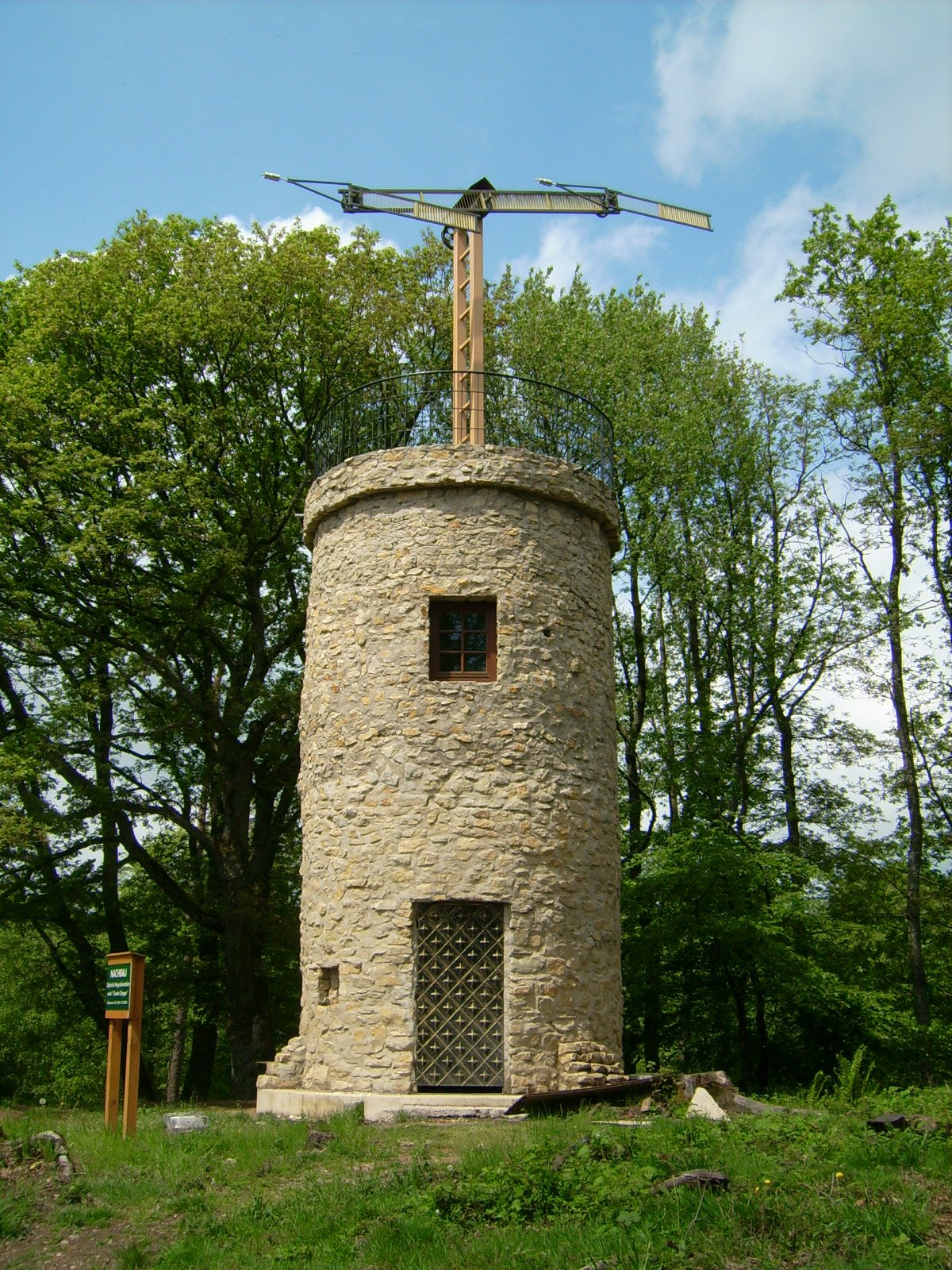
And so we're cautious, sending signals out from the tower in the hope they'll be received as we intended. We don't rock the boat, for fear of capsizing it. Compromise is necessary in any kind of relationship, but when it reaches the level of pathology and an identity is constructed entirely from self-sacrifice, when we're nothing more than a shadow on the lookout for a praiseworthy shape to take, we become as insubstantial as Sylvia Plath's "living doll", a frame for others to hang their wishes on: "You have a hole, it's a poultice. / You have an eye, it's an image.".
The eye is always voracious; the heart desires to beat for another despite the wounds it's so likely to encounter. It's easy to break apart, by ourselves and in our connection to others, and easy to forget that at the center is a place of power and self-reliance we can arm ourselves with, if we rid ourselves of the fears that nag like a thorn in the side.